




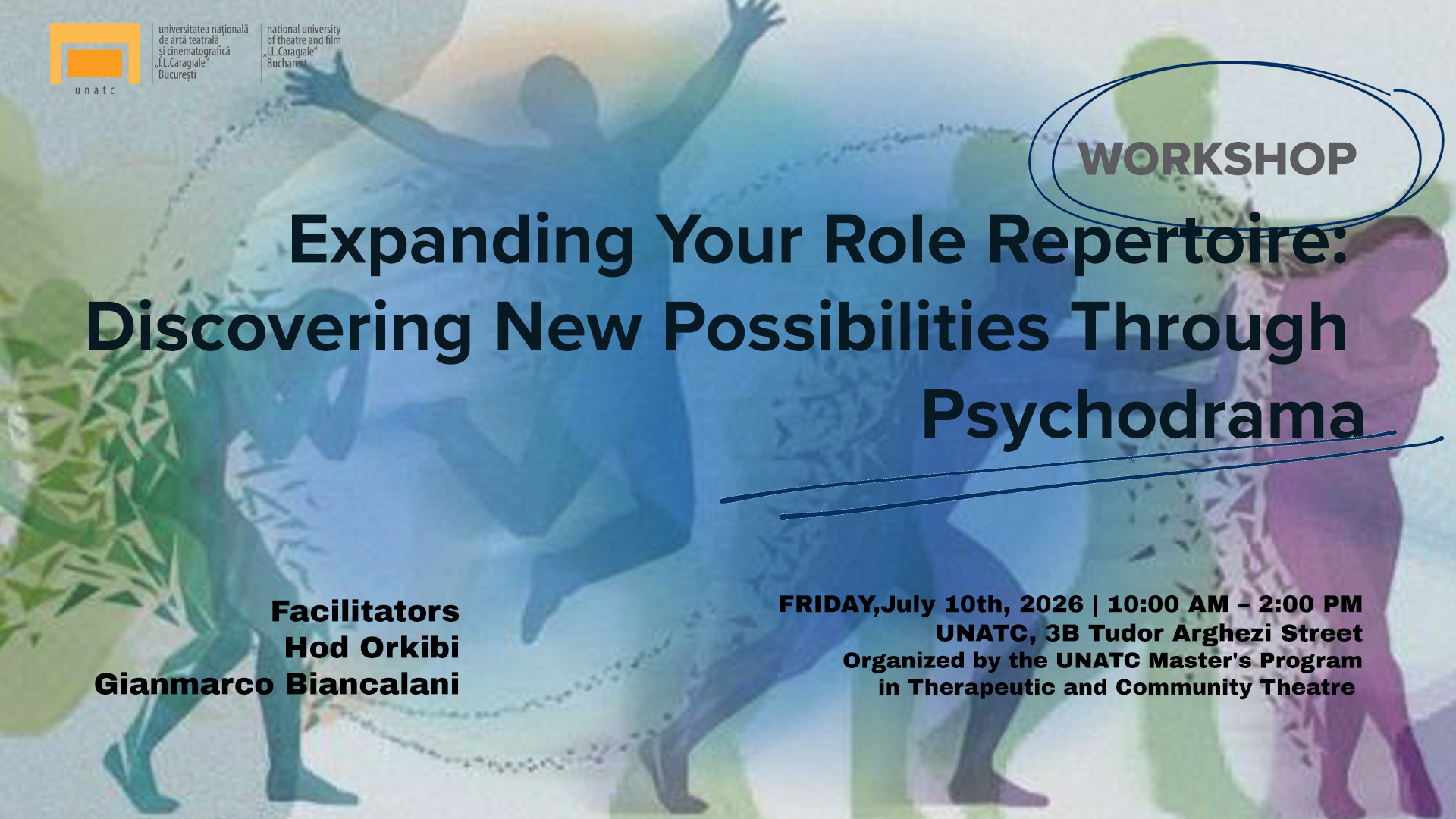
Expanding Your Role Repertoire: Discovering New Possibilities Through Psychodrama
10 July 2026 | 10.00-14.00 | Multifunctionala, CINETIC UNATC (Str. Tudor Arghezi 3-b)
Workshop organised by the Research, Innovation, Development Department in collaboration with the Community and therapeutic theater Master program at UNATC.
The workshop is aimed at students, alumni, teaching staff and researchers of UNATC, as well as professionals interested in the topic, with priority for BA students wishing to enroll in the Community and therapeutic theater Master program at UNATC (see below for details).
If you wish to apply for this workshop, please use the link below. The workshop will be conducted in English.
Every person lives through a rich repertoire of roles across different spheres of life, including family, work, intimate relationships, friendships, and the wider community. While some roles become well developed, others may be neglected, constrained, or no longer reflect who we are or who we aspire to become. According to J. L. Moreno, psychological well-being depends not only on the number of roles we occupy but also on their flexibility, vitality, and capacity for creative development. This 4-hour action-based experiential workshop will introduce participants to the psychodramatic concept of role and provide opportunities to explore, revisit, and expand their own role repertoire. Through carefully structured psychodrama exercises, participants will identify meaningful roles, reconnect with underdeveloped or forgotten aspects of themselves, and experiment with new ways of responding to life’s challenges. The workshop combines action, reflection, and group sharing to foster spontaneity, role flexibility, and personal growth. Participants will leave with a deeper understanding of their role system, practical psychodramatic tools for role development, and renewed possibilities for navigating relationships and life transitions with greater creativity and authenticity.
Facilitators
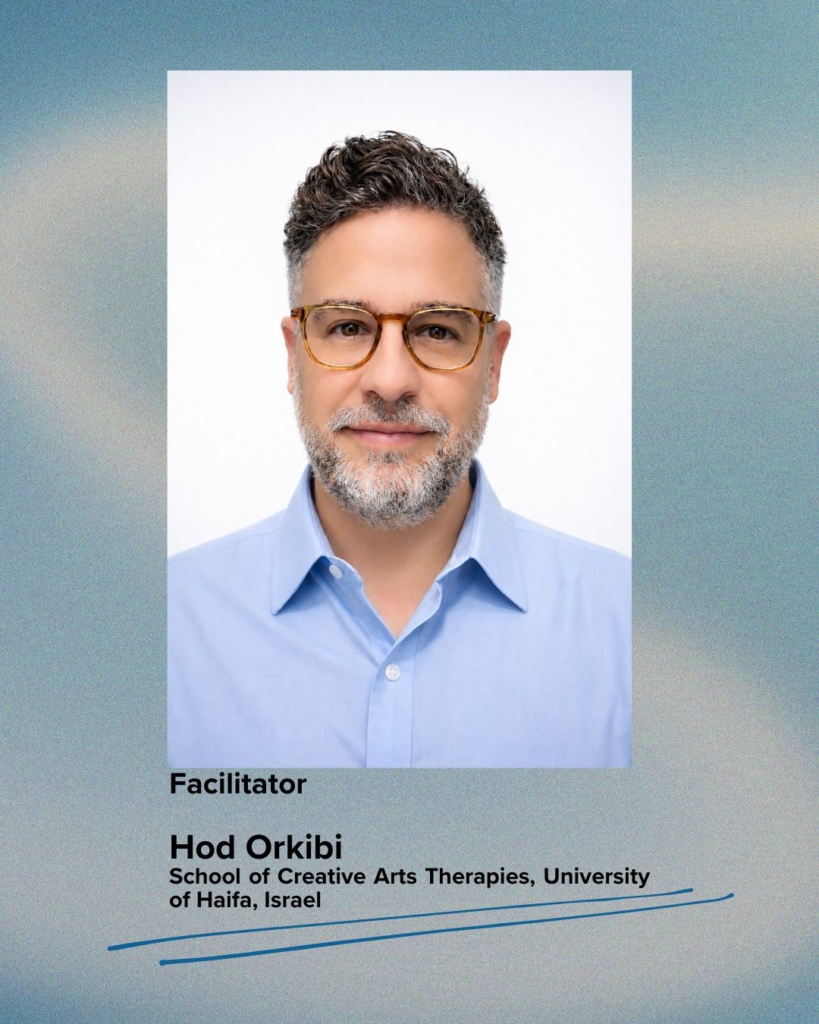
Hod Orkibi, PhD, is a Full Professor at the School of Creative Arts Therapies, University of Haifa, where he serves as Chair of the Doctoral Program and Director of the Drama & Health Science Lab. He also teaches in the Drama Therapy Program at New York University and is an active member of the FEPTO Research Committee. With over 100 publications, his research focuses on psychodrama, spontaneity, creativity, resilience, and the mechanisms of change in action methods. He is also the incoming President of the American Psychological Association’s Division 10 (Society for the Psychology of Aesthetics, Creativity, and the Arts).
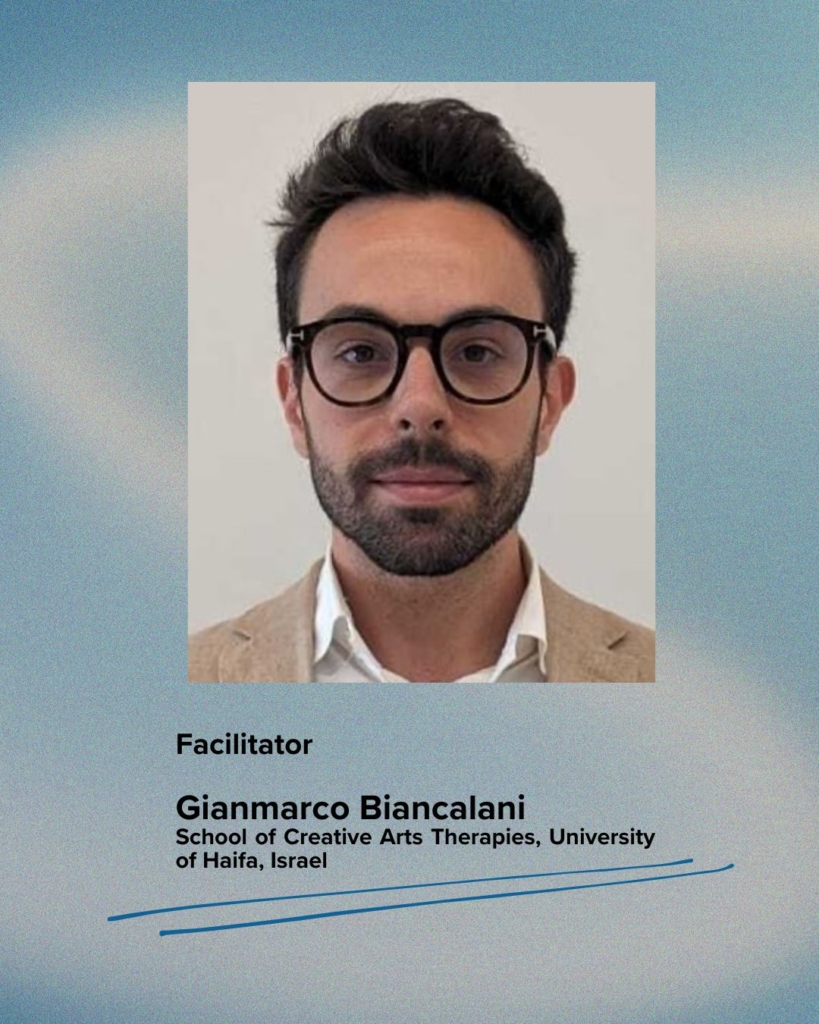
Gianmarco Biancalani is a psychologist, psychotherapist, psychodrama trainer, and PhD candidate at the University of Haifa. His research focuses on psychodramatic processes, spontaneity, creative arts therapies, LGBTQIA+ issues, gay men aging, and death education, resulting in the publication of over 30 research articles in international refereed journals and a book chapter.
Community and therapeutic theater Master
Admission
- DURATION OF STUDIES: 2 years
- CREDITS:120
- ENROLLMENT (BUDGET): 4 students
- ENROLLMENT (TAX): 3 students
- LANGUAGE: Romanian
- STUDY TYPE: with frequency (IF)
Registration period
August 04 – September 09, 2026
Admission period
September 15 – 20, 2026
The general objective of the Community and Therapeutic Theatre master’s program is to add and develop specific skills to explore the transformative potential of theatrical practice, to stimulate the creative engagement of the forms and aesthetics of applied theatre, using as a tool the ethics of intervention and the notions of inclusive practice in working with specific groups.
The activity will focus on theater practices that promote inclusion and will address the ways in which theater can be an agent of change, activation and transformation, in order to diversify the educational offer and complement the skills and knowledge acquired in the professional training of bachelor’s programs.
The study program is aimed at graduates who wish to diversify their possibilities of insertion in the labor market, providing them with skills and techniques for working with vulnerable groups from various social categories. They are trained in the ability to identify and solve the problems faced by an individual or a group, with the aim of increasing their degree of adaptability to the values and norms accepted in society and social inclusion.
Through advanced research and practice of community theatre and therapeutic theatre techniques, they will be allowed to locate and build their own working practice, a continuous and emergent development in a broad understanding of the applied field of theatre and the delivery of a pathway that contributes to involvement, contribution and placement opportunities in organisations across the social spectrum and community institutions.
The study program provides qualification and training to acquire the ability to coordinate and assist in the alternative therapeutic process through the means of acting and performing arts, training researchers in the field of community and social theater, coordinators of community and therapeutic programs with skills for integration and the necessary intervention in working with vulnerable individuals and groups, with social and cultural adaptation difficulties.
Applied theatre, as a form of community intervention, differs from traditional forms in that it has as its main purpose an explicit reparative and therapeutic manifestation. It is carried out in ordinary settings within communities, in hospitals, prisons, it is applied to individuals and groups of people with special needs, people diagnosed with various medical conditions, women or children suffering from domestic violence, adolescents from risk groups, placement centers, elderly groups, community centers, etc.
At the end of the study period, graduates will have: theoretical and practical knowledge of community education through theater; ability to analyze and explore theater performance in a social context; ability to correlate theoretical concepts with key practices in theater applied as a social intervention; knowledge in the correct use of terminology developed by social policies and strategies; ability to identify and analyze social phenomena and use artistic valence in shaping a strategic perspective; ability to understand and practice within structures, associations, non-governmental organizations; understanding of the social responsibilities related to the profession and the ability to contribute to the development of the field; research skills and the development of articles and studies on community theater, the impact of theater in everyday life as well as its therapeutic effects; skills in the effective use of methods, principles, rules and techniques specific to community and therapeutic theater; ability to encourage and support the initiatives of specialized NGOs in preventing and remedying problems among vulnerable groups in the community; personal skills in order to adapt to the requirements of the professional competence profile (balance and objectivity, cognitive, affective and volitional psychological qualities, communication and relational availability); ability to create professional networks in the socio-cultural and artistic field and to organize, lead, supervise therapeutic-educational processes in the cultural-artistic sector; ability to make decisions under pressure.
Professional skills acquired by the graduate:
- knowledge of specific techniques for using theatrical instruments within an intervention program;
- knowledge of terms and concepts specific to community and therapeutic theater;
- knowledge of the characteristics of community theater in improving social skills at a personal and group level;
- developing a teaching style;
- knowing how to reconcile the personal needs of participants with those of the group;
- the ability to use pedagogical strategies to facilitate the development of creativity;
- the ability to gather information about the group of participants;
- the ability to design targeted, cultural and educational activities;
- the ability to contextualize artistic activity;
- the ability to coordinate community arts activities;
- having the ability to define an artistic approach;
- works in interdisciplinary teams;
- the ability to apply the creative process for self-knowledge and expression and personal development;
- communication and teamwork skills;
- interdisciplinary use of knowledge;
- applies organizational techniques;
- They carry out their activities in health, education, social protection, cultural institutions or services, and counseling centers.
The professional options of this form of education are multiple, being correlated with the Romanian Occupational Classification Nomenclature – COR, with the occupational standards developed by NCTPE and with the professional training standards imposed by Directorate-General for Education and Culture, European Commission:
The basic competencies are found in COR in Major Group 2 – ““Specialists in intellectual and scientific occupations who develop the existing stock of knowledge, systematically apply scientific or artistic theories and concepts, or engage in any combination of these activities”
30.06.2026