



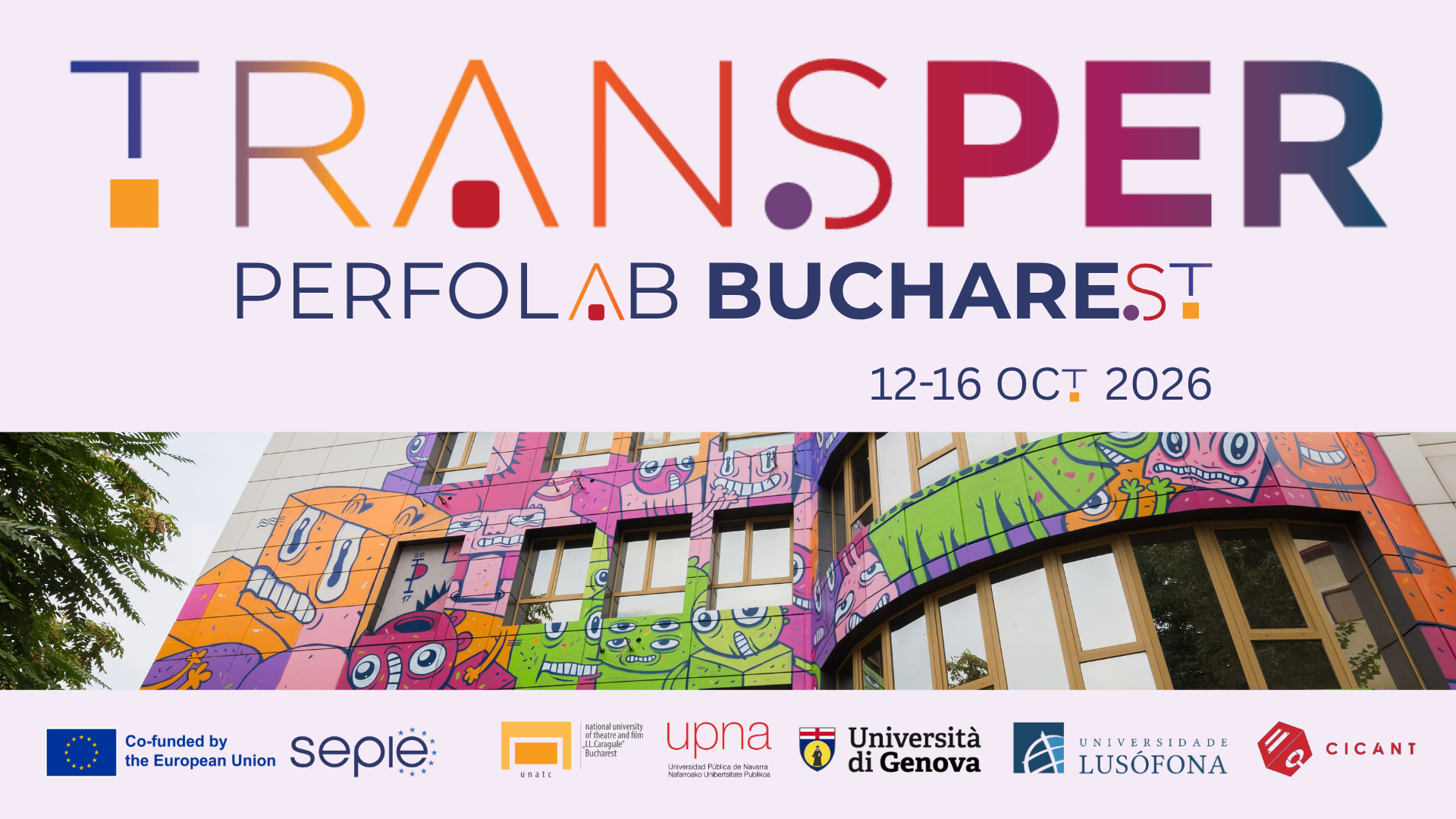
TRANSPER — Perfolab Bucharest
A week of performing arts and technology projects with students in interactive technologies, dance, digital humanities, and computer engineering degrees from Romania, Italy, and Spain, focused on embodiment, nature, and social connection.
THIRD Pilot Workshop on transdisciplinary methodologies in Performing arts and technologies. Other TRANSPER Pilots.
12-16 October 2026
Main theme: PerfoLab on Embodiment as a Path to Connection (Mental Health, Nature Interaction, Social Inclusion)
Entry points
- Mental health and digital media: cyberbullying and disembodied vulnerability
- Harnessing nature through technology
- The social inclusion of vulnerable groups from remote areas and of migrants
Mental health and digital media: cyberbullying and disembodied vulnerability
Social interactions are quintessential for human wellbeing, yet digital media interactions occupy more and more of our lives, sometimes affecting our mental health and wellbeing. The core concepts of this challenge are vulnerability, visibility, embodiment, care, interconnectedness, social interactions, and risk-taking. Vulnerability — is a relational condition shaped by individual circumstances, peer relationships, and technological environments. During adolescence, sensitivity to social approval and exclusion can make online interactions particularly consequential for mental health, especially in the context of the higher risk-taking behaviours associated with adolescence. Visibility — invisibility is often associated with mental health. In the context of cyberbullying, it can start with seeking recognition and participation and can lead to unwanted exposure and public humiliation. While individuals can become highly visible in digital media, their distress can remain unseen. Embodiment — digital media abruptly transformed the way we interact. Heavy exposure to digital media can be associated with depersonalisation, bodily experiences of anxiety, disrupted sleep, and withdrawal into non-embodied interactions mediated through text, images, and avatars. Although digital interactions lack physical co-presence, their consequences become embodied. Care — from education and prevention to moderation, peer support, and professional intervention, digital assistance can connect with supportive relationships and environments and provide solutions for improving mental health in large populations.
Case Study
Cyberbullying among adolescents illustrates these interdependencies and solutions. WHO/Europe’s 2024 report found that approximately one in six adolescents across the surveyed countries and regions experienced cyberbullying. Research associates victimisation with depression, anxiety, and lower self-esteem. Consider an adolescent whose manipulated image circulates through a school messaging group, accompanied by derogatory comments and exclusion. Their representation becomes an object of collective attention, while their lived experience remains overlooked. Harassment extends into the home through persistent messages and notifications, potentially disrupting sleep, generating bodily tension, and undermining school participation. In applying our T-NET theatre improvisational method, developed to contribute to better social interactions in the classroom, mobile phone use was the primary disruptive behaviour, sometimes preventing teenagers from interacting in person and even triggering avoidance behaviours. How can interactive technologies and digital environments be harnessed to contribute to in-person social interactions without diminishing them? Interactive technologies could support digital literacy, bystander education, confidential reporting, and access to support. Non-embodied experiences, including anonymous text interfaces or avatars, may facilitate disclosure; embodied experiences involving voice, movement, or shared physical spaces may support emotional expression and rebuild trust. AI-assisted moderation could prioritise concerning interactions for human review, while specialist conversational interventions require evaluation of their benefits and limitations. How can interactive technologies connect these experiences, preserve adolescents’ agency, and transform cyberbullying into a shared responsibility of platforms, schools, and communities? How can they create pathways from digital exposure to embodied safety, care, and belonging, while distinguishing increased engagement or faster responses from demonstrated improvements in mental health?
References:
Alexandru I. Berceanu is an Associate Professor in the Department of Animation and Interactive Media at the National University of Theatre and Film “I.L. Caragiale” in Bucharest, Romania, where he also teaches in the Master’s programme in Community and Therapeutic Theatre. He initiated the International Center for Research and Education in Innovative and Creative Technologies (CINETic). His research focuses on emotion regulation, memory, aggressive and prosocial behaviour, bridging neuroscience, theatre, play, immersive environments, and gamified approaches. His research has been published in international journals, and his artistic practice spans interactive installations, virtual reality, immersive environments, animation and theatre. He developed T-NET, an improvisational theatre approach designed to develop emotion regulation skills in adolescents who have experienced adverse life events.
Harnessing nature through technology
1. Bacteria are rapidly mutating to survive modern antibiotics faster than pharmaceutical science can engineer new ones. How can we use non-pathogenic bacterial growth or genetic simulation algorithms to make the invisible spread of resistance tangible in textiles, art, or computational media? Link
2. Rising atmospheric carbon is turning oceans acidic, while ancient organisms (Archaea) thrive in extreme, toxic hydrothermal environments that mimic both early Earth and potential climate-collapsed futures. How can we design speculative robotic “creatures,” generative code, or neural networks modeled on the survival mechanisms of extremophiles under toxic conditions? Link
3. Global data production is exceeding the physical limits of silicon microchips, driving research into storing digital files inside synthetic DNA sequences (A,T,C,G). How can we translate human language, images, or digital software into base-pair sequences or build algorithms that simulate synthetic genetic selection and mutation? Link1 Link2
4. Traditional silicon chips require toxic rare-earth metal extraction and produce massive e-waste, whereas biological mycelium networks naturally process signals and adapt to their environment. How can we interface microcontrollers directly with fungal electrical impedance to generate bio-synthesizer audio, or use mycelium growth as physical computing inputs? Link
Examples of artworks combining tech and nature science
The social inclusion of vulnerable groups from remote areas and of migrants
The core concepts of this challenge are inclusion, remoteness and vulnerability, and the way they interconnect.
Inclusion – as social inclusion, but also generically as being a part of a whole, be it an imaginary, psychological, corporeal, societal, cultural or a political body.
Remoteness – from conceptual remoteness to its physical manifestation as spatial, cultural and social exclusion
Vulnerability – from embodied vulnerability to being rendered invisible and inexistent
To exemplify how these concepts interconnect in practice we could use two case studies.
Case study 1
Roma bodies as victims of floods and toxic waste in Rosia Montana being relegated to the invisible margins of an otherwise internationally visible community due to its successful struggle against a corporate mining project. The Roma from Rosia Montana have not been included in the mining project, neither in the internationally recognized environmental movement against the mining project, nor in the alternative development projects, or in the UNESCO heritage area of the locality. They have been treated as if they have not existed, although they constitute a highly dense neighbourhood of about 800 souls, yet unintegrated either as bodies equally deserving protection from environmental disasters and social integration, but even ignored conceptually. The premise is that hidden, invisible areas of vulnerable content render the vulnerable invisible, but not less real. The challenge is how to make this vulnerability visible and how to integrate it into an embodied whole of what is the current post-ming space of Rosia Montana. If we think of the locality as a body, or as a puzzle, the Roma neighbourhood is a missing piece of the whole, yet treated as if the locality has always been without it, an unfinished puzzle that forgot its missing piece. The challenge is that of remembering the whole, or imagining what the whole could be, to render back into existence the repressed content of the social body (i.e. the excluded vulnerable community) through digital and embodied practices. How could digitalisation help make this community visible as an equally deserving part of Rosia Montana, first perhaps conceptually, as an imaginary construct, and how could one then blow life into it through embodied cultural and political practices of inclusion?
Resources:
Romania’s Glittering Secret: Gold & Quartz of Rosia Montana. – YouTube
Memories of Red: Gold Mining in Romania’s Rosia Montana – YouTube
- Rusu, O., F. Alexandrescu, I. Bunescu, I. Codreanu, C. Gheorghe, and I. Velicu. 2026. “ Insidious Whiteness in Eastern Europe: Environmental Injustice and Dehumanisation in a Roma Community.” Antipode 58, no. 3: e70170.
- Bunescu, Ioana, 2016. Roma in Europe. The Politics of Collective Identity Formation, Routledge NY.
Case study 2
Migrants often are an embodied paradox of movement across borders and spatial enclosure into remote camps or other forms of detention with no access to basic rights (as a minimum, access to information about their own rights i.e. about the asylum procedure). The spatial encampment, remoteness and separation from the daily life of the host societies are used as forms of deterrence of movement and integration. From the point of view of the host societies, the spatial encampment is a form of insulating against a perceived threat; from the point of view of the migrants, the spatial encampment is often the price to pay for their hope to pursue a safer and freer life by taking the risk to leave behind their war-wrecked or poverty-stricken countries and move across borders. The tension between these two ways of thinking and acting are mirrored into political decisions at European and state level, and directly affects the interaction (or lack thereof) between migrants and local citizens. How could digitalisation play a positive role to ease this tension and bridge the gap of mutual knowledge (getting to know the “stranger”), normalise the difference and similarity between these people and hence facilitate better integration? How could digitalisation play a role in creating an expanded field of knowledge and cultural production, where migrant and local knowledge and culture cross-fertilise?
Resources:
Behrouz Boochani’s literary prize acceptance speech – full transcript | Refugees | The Guardian
This Syrian artist paints world leaders as refugees. | Al Jazeera English | Facebook
Burnard, P., Mackinlay, E., & Powell, K. (Eds.). (2016). The Routledge International Handbook of Intercultural Arts Research (1st ed.). Introduction and Overview (p. 1- 9) Routledge, NY. https://doi.org/10.4324/9781315693699
Chalenges of the Bucharest Perfolab
This workshop invites students to explore embodiment as a path to connection, investigating how physical experience can mediate our relationships with technology, nature, society, and digital environments. Through movement, sound, performance, and 3D environments, the workshop examines the tensions and possibilities between the physical and the digital: how digitalisation affects perception, cognition, and mental well-being; how technology can deepen our relationship with natural and biological processes; and how embodied digital experiences can create new forms of cultural participation and social inclusion for people in remote or underserved communities, including migrants.
The workshop approaches the body as a source of knowledge, expression, and connection. Students will investigate movement as data, sound as a spatial and embodied experience, and digital environments as spaces for interaction and collective participation.
Participants will learn to capture, interpret, sonify and visualise movement, while also exploring how these processes can become material for performance, installation, scenography, and interactive environments.
Students will work in mixed interdisciplinary teams, integrating backgrounds in the arts, humanities and technology, and bringing together participants from the three partner universities. Each team will present a creative research prototype, in the form of technology-based performances, interactive installations, live-coded environments, or site-specific/public-space interventions. The projects will emphasise collaboration across disciplines: technical students participate as performers and co-creators, while students from the arts contribute to the conception and development of technological solutions.
The intended outcome is therefore twofold: an artistic performance enabled by technology, and a technological/engineering solution shaped by artistic practice.
Invited Speakers at Perfolab Bucharest
- Alexandra Ciocan, biologist, Institute of Biology Bucharest https://www.ibiol.ro/en/index.html
- Anna Dumitriu, bioartist https://annadumitriu.co.uk/
- Ioana Bunescu, sociologist and researcher https://orcid.org/0000-0002-3266-0295. Ioana Bunescu is a researcher on vulnerable groups, migration, asylum and environmental justice in Europe. She holds a PhD in sociology from the Polish Academy of Sciences since 2009 and she has published on issues related to the Roma minority in Europe, including the monograph “Roma in Europe. The politics of collective identity formation” published by Routledge in 2016. She has been a researcher formerly affiliated to Malmö Institute for Studies of Migration Diversity and Welfare in Sweden and senior lecturer across the curriculum in European Studies and Global Political Studies at Aalborg University and Roskilde University in Denmark. Upon her return to Romania, Ioana was a researcher at New Europe College Institute of Advanced Studies in Bucharest and at Lucian Blaga University of Sibiu. More about Ioana’s research profile and a sample public lecture here.
Perfolab Bucharest Highlights
CONTEMPLA(c)TIONS – movement stage, Valentina de Piante & Teodora Velescu
For Valentina De Piante, dance is a powerful cognitive, social and political tool. Passionate about neuroscience, art and inclusion, the choreographer leads experiential workshops for a wide audience, where attention to the body—largely unknown, unconscious, immeasurable and unweighable, with its many emotional entanglements—guides participants towards movement and inner sensation. After moments spent listening to the body, the senses and micro-actions, the dance that each person creates follows. Valentina draws on the Feldenkrais Method to deconstruct movement habits, working with the phases of breathing and bodily dynamics, and with everyday gestures that are amplified or reduced until they become abstract.
Valentina De Piante is an Assistant Professor at the I.L. Caragiale National University of Theatre and Film in Bucharest, Doctor of Performing Arts, choreographer, performer, project coordinator, and a Feldenkrais Method®️ practitioner. In 2020, she co-founded the Areal – Space for choreographic development and has collaborated closely with Indie Box, engaging in durational performances, community workshops, and research residencies. Her performances have been showcased at notable venues like Explore Dance Festival, the National Center of Dance in Bucharest, Trois C-L in Luxembourg, and the ImPulsTanz Festival. A major part of her choreographic work involves exploring consciousness through circumferential perspectives, often bridging art with scientific research. She was also involved in DanceBrainRehab, an Erasmus+ project, applying neuroscience to dance for vulnerable communities. In 2020, she received the CNDB prize for independent artists and published Body of Knowledge in 2021. Nowadays she is supporting a larger community on the topic of inclusion through the national project C.R.E.S.C.-network of creation, education, health, research. https://arealcolectiv.ro/
Infective Textiles – workshop by Anna Dumitriu, bioartist (UK)
Where is the middle point between plant knowledge, scientific investigation and artistic inquiry? The workshop Infective Textiles, held by bioartist Anna Dumitriu and biologist Dr Alexandra Ciocan, is a hands-on exploration of the science behind two remarkable plants: smoke tree and edelweiss. Working with plant extracts and bioactive compounds, participants will investigate their antimicrobial potential and experiment at the crossover between lab research and artistic practice.
Anna Dumitriu is an award winning, internationally renowned, British artist who works with BioArt, sculpture, installation, and digital media to explore our relationship to infectious diseases, synthetic biology, AI and robotics. She has an extensive international exhibition profile including The Nobel Prize Museum, ZKM, Ars Electronica, BOZAR, The Picasso Museum, Kunstlerhaus Vienna, MIT Museum, Liljevalchs, MOCA Taipei, Kunsthal Charlottenborg, HeK Basel, LABoral, Art Laboratory Berlin, Taipei Fine Arts Museum, the 6th Guangzhou Triennial, and The History of Science Museum Oxford. Her work is held in major collections including ZKM, the Science Museum London and Eden Project.
Generating content for 3D scenography (CAVE), Ciprian Facaeru & Dragos Dogioiu
Building on the COSCENIUM pilot research, this workshop explores human-AI co-creation as a practice-based workflow in a CAVE-based virtual environment infused with agentic AI architectures that enable orchestration of multimodal generative AI models. Conceived as a performative improvisation apparatus, the practice evolves iteratively from idea to staged situation via a conversational interface, establishing an evolving dialogue between performer and an artificially intelligent virtual environment. Participants experiment with AI-assisted prototyping within an XR environment to investigate how synthetic media can become a performative environment.
*Ciprian will lead the XR component, focusing on spatial composition and CAVE-based virtual scenography, while Dragoș will introduce the AI component, including agentic workflows and the orchestration of multimodal generative models
Ciprian Făcăeru is a new-media researcher, immersive-space architect and XR practitioner working at the intersection of performing arts, spatial design and emerging technologies. A research assistant at CINETic/UNATC’s Digital Interaction Lab, his practice focuses on XR, virtual and hybrid scenography, embodied experiences, CAVE-VR systems and generative AI as tools for artistic experiments and research.
Dragoș-Ion Dogioiu is a new-media artist, XR designer and educator whose practice spans animation, virtual reality, interactive installations and generative AI. A member of kinema ikon, he teaches VR, AR and world-building at CINETic/UNATC. His work investigates memory, archives and experimental digital storytelling and has been presented internationally, including at Ars Electronica.
Introduction to interactive sound design, Stefan Damian
The workshop provides some basic information related to spatial hearing and some of the basic tools for creating and interacting with spatial audio content. We will briefly discuss about sound propagation, spatial perception, limitations of human hearing, sonic perspective; as well as sensors, designing basic interaction patches in Max and real-time manipulation of audio.
Ștefan Damian teaches sound design at UNATC. His artistic exploration revolves around sonic interaction design, sound spatialization, sound synthesis / transformation algorithms and the artistic and social contexts in which they can coexist, in a highly expressive way.
Interactivity through muscle sensors, Mara Olaru & Grigore Burloiu
Muscles play a huge role in one’s performance, but what if we could use them to further enhance the way we interact with art? In this workshop we will learn how muscle sensors work, how we can integrate them in our projects, by getting our hands dirty with a bit of science and programming.
Don’t worry if you’ve never interacted with programming before, we will go through some basics before developing something. I recommend watching a few short, beginner friendly videos that will help you understand better
- Arduino explained: https://youtu.be/tiGw9PQbvrg , https://youtu.be/aRT3kPGD9U0
- How muscle sensors work: https://youtu.be/A7l0A8NjV4c
Happy exploring 😉
Grigore Burloiu is a Lecturer in the Animation & Interactivity department at the National University of Theatre and Film in Bucharest, where he teaches Creative Coding, Interactive Music Systems and Game Development, and coordinates the Interactive Technologies for Performing and Media Arts M.A. Grigore develops systems for expressive accompaniment and for interactivity in art. In 2024 he participated in the MODINA project alongside Simona Deaconescu with a lecture-performance where he developed AI systems for music and text interaction. He has also done practice-led research into motion and gesture sonification for interactive performance. His artistic collaborations have been presented internationally in venues such as Ars Electronica (AT), Vivid Festival (AU), Fete des Lumieres (FR), Prague Quadrennial of Performance Design and Space (CZ).
SCHEDULE
Day 1 (12 Oct – Monday)
9.30 – Tour of Institute of Biology, Department of Developmental Biology
Step inside the Institute of Biology’s Developmental Biology Department, a specialized research hub dedicated to preserving Romania’s rarest endemic and endangered plant species through state-of-the-art in vitro tissue cultivation. Beyond biodiversity conservation, the department’s laboratories actively investigate the therapeutic potential of calli plant extracts, uncovering innovative medical applications hidden within plant cellular structures. Guided by researcher Alexandra Ciocan, we’ll explore her ongoing bio-art collaboration with artist Anna Dumitriu for Otherwise Residency #2 – examining the antimicrobial power of edelweiss and smoketree calli – to see how living science and high-tech plant labs can fuel bold new visual, theatrical, and cinematic narratives, before diving into this together during their workshop on October 15.
10.30 – Meeting teams & mentors. Introduction to the TRANSPER Pilot Labs. Oscar Ardaiz
12.00 – The social inclusion of vulnerable groups from remote areas and of migrants. Ioana Bunescu, sociologist and researcher
13.00 – Lunch break
14.00 – Mental health and digital media: cyberbullying and disembodied vulnerability – Alexandru Berceanu, associate professor, researcher UNATC
15.00 – Choosing workshops and mentors, initial discussions
16.00 – CONTEMPLA(c)TIONS – movement stage, Valentina de Piante & Teodora Velescu
Day 2 (13 Oct – Tuesday)
9.30 – CONTEMPLA(c)TIONS – movement stage, Valentina de Piante & Teodora Velescu
11.00 – Parallel workshops:
- Generating content for 3D scenography (CAVE), Ciprian Facaeru & Dragos Dogioiu
- How to compute descriptors of human movement? Gabriele Romano & Gualtiero Volpe
- Live Coding with Movescript, Urki Aristu & Josu Irisarri
12.30 – Lunch break
13.30 – Parallel workshops:
- Introduction to interactive sound design, Stefan Damian
- Interactivity through muscle sensors, Mara Olaru & Grigore Burloiu
- Interactivity in Virtual Reality with 3.js-WebXR, Urki Aristu
14.30 – Teams & mentors brainstorming
Day 3 (14 Oct – Wednesday)
9.30 – CONTEMPLA(c)TIONS – movement stage, Valentina de Piante & Teodora Velescu
11.00 – Development and prototyping
12.30 – Lunch break
13.30 – Development and prototyping
Day 4 (15 Oct – Thursday)
9.30 – Movement stage // Performance rehearsals, Valentina de Piante
11.00 – Preparation for rehearsal
11.30 – Public rehearsal & mentor feedback
13.00 – Lunch break
14.00 – Infective Textiles, workshop by Anna Dumitriu, bioartist (UK)
Day 5 (16 Oct – Friday)
9.30 – Final rehearsal
11.00 – Preparation for final event
12.00 – Public project presentations [5 min setup + 5 min performance each]
13.30 – Lunch break
RESOURCES
- Performance Artists
- MoCap
- Multimodal Systems
- PyEyesWebTD
- MotionScript
- Movement Sonification
- Immersive Technologies
- LiveCoding
- Mental health and digital media: cyberbullying and disembodied vulnerability
- The social inclusion of vulnerable groups from remote areas and of migrants
- Anna Dumitriu (Bio artist and workshop host)
The event is part of the TRANSPER project.