
COSCENIUM – Open Lab
Toward a Framework for Human–AI Co-Creative Performance Practice in CAVE-Based Virtual Immersive Environments
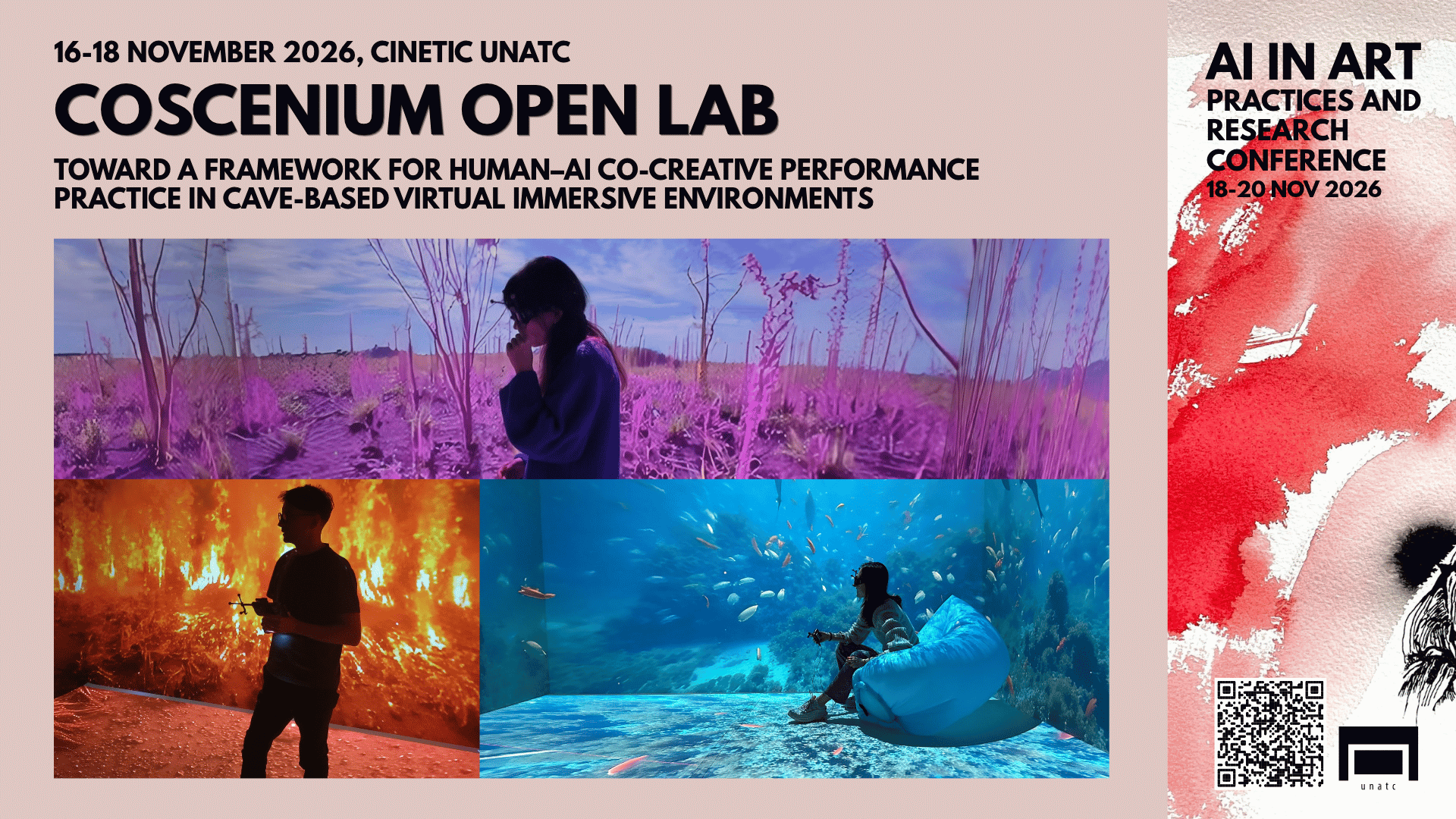
COSCENIUM Open Lab is an open laboratory for artistic research and collaborative experimentation at the intersection of performing arts, generative artificial intelligence, and immersive virtual environments.
Taking place on 16–17 November 2026, in the CAVE laboratory at CINETic–UNATC, the Open Lab invites participants to engage in individual and collaborative exploration through improvisation and prototyping.
Participants will investigate how creative authority is distributed and negotiated in interactions with intelligent systems, examining the relationships between AI interventions, embodied experience, and the development of performative situations.
Micro-experiments, process documentation, and collective reflection will inform future directions for the artistic and technological research undertaken within the COSCENIUM project.
Location: CAVE Immersive Laboratory, CINETic, DCDI–UNATC, 3-b Tudor Arghezi Street, Sector 2, Bucharest, 020941, Romania (behind the National Theatre Bucharest).
Eligible Participants: Undergraduate, master’s, and doctoral students; academic staff; researchers; artists; and practitioners from the performing arts and related fields who are interested in interdisciplinary experimentation and human–AI co-creation in immersive virtual environments.
Aim: To explore human–AI co-creation in digital environments through improvisation, prototyping, testing ideas, and reflecting on the artistic process.
Expected Outcomes: A selection of documented micro-experiments, a critical synthesis of observations, and recommendations for advancing artistic and technological research.
Programme
Monday, November 16 – Exploration and Research Questions
11:00–12:00 – COSCENIUM Open Lab Opening
Introduction to the project and participants.
12:00–13:00 – Introduction to the Available Infrastructure and Tools
Demonstration and hands-on testing.
13:00–14:00 – Discussion and Ideation
14:00–15:00 – Lunch Break
15:00–17:30 – Open Exploration I
Testing AI-generated proposals as starting points for performative actions, texts, scores, and other creative explorations.
17:30–19:00 – Reflection and Closing Discussion
Tuesday, November 17 – Prototyping, Testing, and Reflection
11:00–12:00 – Revisiting the Discussion
Reviewing observations and selecting directions for experimental prototyping.
12:00–14:00 – Developing Micro-Experiments
Creating short performative sequences and defining the research questions, roles, rules, and AI interventions involved.
14:00–15:00 – Lunch Break
15:00–17:00 – Testing and Revision
Repeating performative sequences while modifying one element at a time to observe its effects on artistic decision-making. Documenting successive versions and the challenges encountered.
17:00–19:00 – Collective Reflection and Closing Session
Discussing the contribution of AI, its limitations, and the observations emerging from the exploratory process.
Wednesday, November 18 – Live Demo
16:15 – Live Demonstration
COSCENIUM – Research Pilot
Toward a Framework for Human–AI Co-Creative Performance Practice in CAVE-Based Virtual Immersive Environments
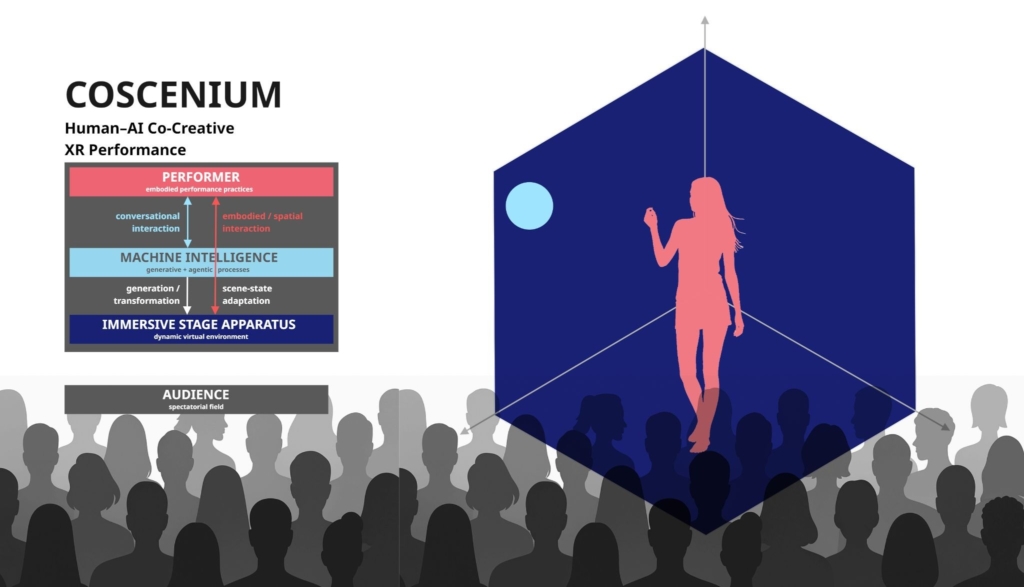
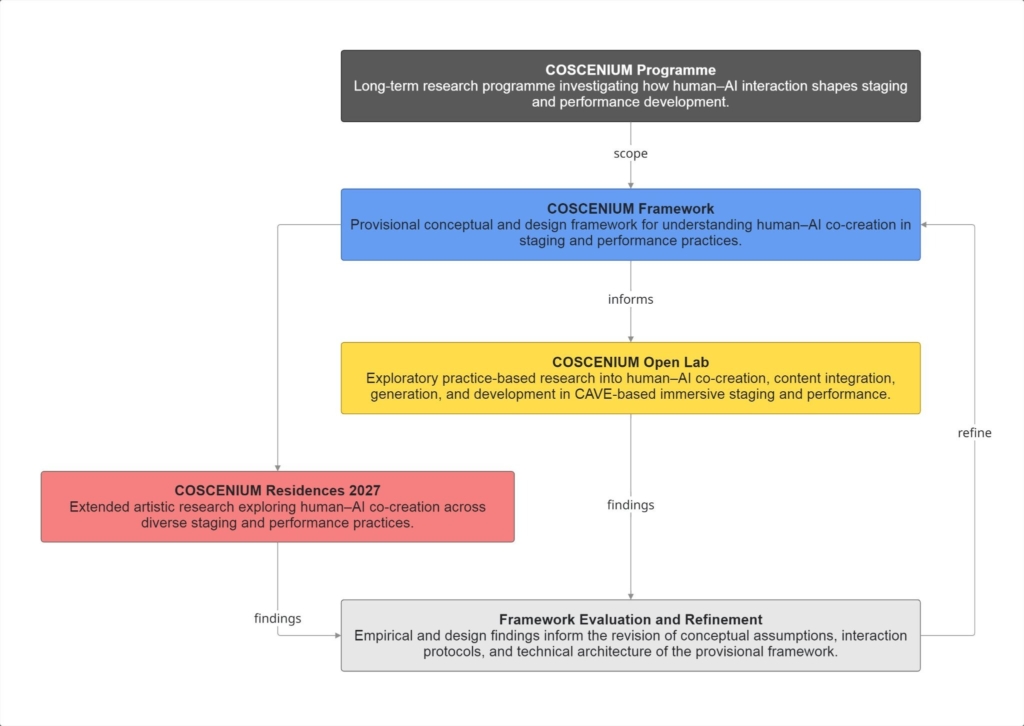
COSCENIUM is a research-through-design programme that develops an artist- and practitioner-centred framework for designing, analysing, and evaluating human–AI co-creative performance practices involving generative artificial intelligence and bounded agentic orchestration in CAVE-based immersive virtual environments.
The programme conceptualises staging as a situated, embodied, and temporally structured process of performance creation, in which artists and creative practitioners interact with emerging computational systems and generative environments to compose and transform evolving performative situations.
A central concern of COSCENIUM is the configuration and distribution of creative authority within performance practices that integrate intelligent and generative systems into immersive virtual environments.
The programme analytically distinguishes seven forms of creative authority: initiation, contribution, modification, approval, interruption, reversal, and finalisation.
The research examines who can exercise these forms of authority, under what conditions, and at which moments of the creative process, investigating the implications of these configurations for the continuity of embodied engagement, dramaturgical development, and transformations of the performative state.
I’ve kept the translation close to the Romanian original while refining the English for an international academic and artistic research audience. The terminology is consistent across both sections, particularly regarding creative authority, embodied engagement, research-through-design, and human–AI co-creation. British English spelling is used throughout.
Facilitators
CAVE Research team coordinated by dr. Ciprian Făcăeru
Ciprian Fācāeru is a pioneer of the XR scene, with over a decade of creative inquiry, design-led practice, and production at the forefront of emerging media technologies.
Research assistant within the Department of Research, Development and Innovation, CINETic – UNATC, co-founder of the Augmented Space Agency studio and Space Continuum association, Ciprian is one of the representative figures of XR practices in Romania.
Architect of immersive spaces, director of augmented experiences, and researcher of new media practices. His work is situated within the expanding continuum between physical and virtual space, tangible and intangible data, human and artificial intelligence. In this context, he examines how contemporary technologies reconfigure perception, presence, and modes of being in the world.
To navigate this expanse, he centres his design philosophy on agentic–environmental framework that guides the development of immersive systems structured around augmented human agency, extended spatial conditions, and mediated relations between bodies, technologies, and the built, virtual, and hybrid worlds they inhabit. Through this approach, he frames immersive media as a transdisciplinary territory operating across cultural, educational, scientific, industrial, and civic domains, transforming the ways spaces are imagined, narrated, experienced, and inhabited.