




MOVIDA – Movement and Virtual Intelligence for the Development and Accessibility of Artists and Audiences
MOVIDA – Movement and Virtual Intelligence for the Development and Accessibility of Artists and Audiences
Duration: 1 APR 2026 – 31 MAR 2029 (3 years)
Call: Project 101255836 — CREA-CULT-2025-COOP-2 (Creative Europe)
Project grant: €999,953 (UNATC share: €108,214)
Partners: Tallinn University (EE), SoltumatU Tantsu Uhendus (EE), Hochschule Duesseldorf – University of Applied Sciences (DE), Tanzhaus NRW eV (DE), IST-ID Associacao do Instituto Superior Tecnico (PT), O Espaço do Tempo – Associação Cultural (PT), UNATC “I.L. Caragiale” (RO), CNDB (RO), Nomad Dance Association (BG), Asociatia Entuziart (RO), Mittetulundusuhing Peaasjad (EE).
Description: MOVIDA explores the use of Artificial Intelligence and related technologies, including Virtual Intelligence (AI combined with VR/AR) and Embodied AI (the integration of AI into robotic systems), in the field of contemporary dance. The project aims to strengthen artistic capacity, improve accessibility for people with disabilities and mental health conditions, and develop new forms of audience engagement.
The project promotes a human-centered and responsible approach to AI, addressing issues such as copyright, data ownership, employment impact, and sustainability, while contributing to the European debate on the ethical use of AI in the cultural and creative sectors.
MOVIDA LABS for Artist Duos (Dance and Technology)
MOVIDA is organizing 4 Labs of 9 days each, between December 2026 and February 2027, in 4 countries: Estonia, Germany, Portugal and Romania.
- AI, accessibility and dance. Bucharest (CNDB/UNATC), 3-11 December 2026
- AI, AR/VR and dance. Düsseldorf (Tanzhaus NRW/HSD), 13-21 January 2027
- AI, robotics and dance. Lisbon / Montemor-o-Novo (OEDT/ITI), 1-9 February 2027
- AI, mental health and dance. Tallinn (STL/TLU), 3-11 February 2027
More information: https://movida.dance/news/call-labs/
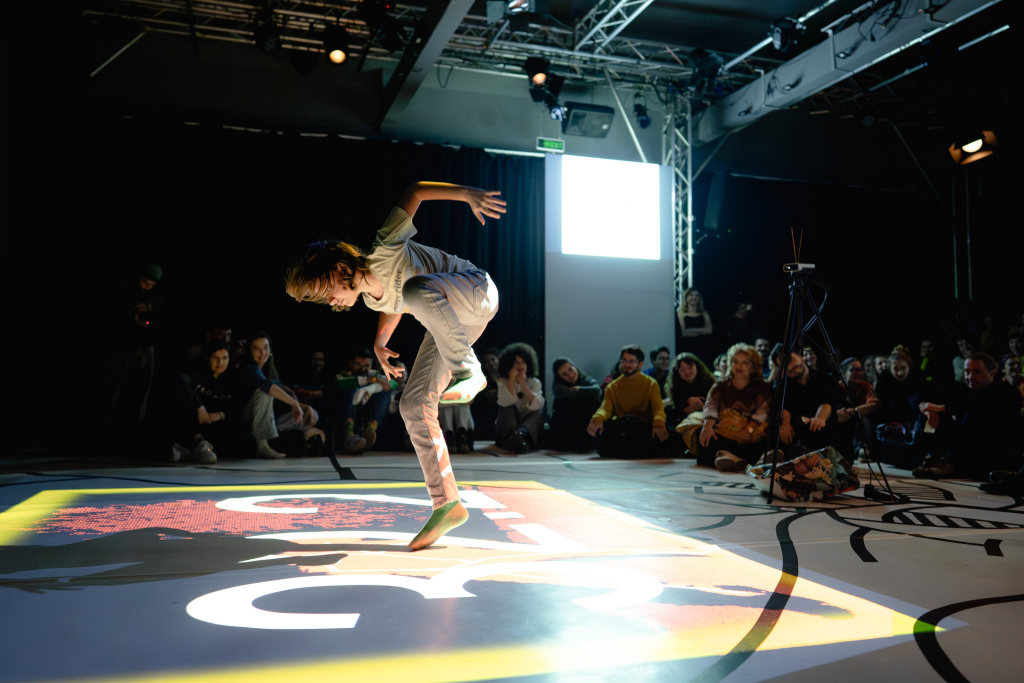
— Image info: Dancer jumping over a video projection on the floor with numbers and graphics. The audience is sitting in the background. Project: „Gaitless”, from MODINA. Photographer: Claudiu Popescu
About
Movement and Virtual Intelligence for the Development and Accessibility of Artists and Audiences (MOVIDA) aims to explore the possibilities for Artificial Intelligence (AI) and related technologies in contemporary dance to: build capacity for artists; use these technologies for audience development and engagement; and improve accessibility for persons with disabilities and mental health issues.
Recent developments in AI, particularly Virtual Intelligence, the combination of AI, Virtual Reality (VR) and Augmented Reality (AR); and Embodied AI, the integration of AI into physical systems through robotics; provide dancers with a new world of possibilities for their artistic development.
These developments can enable novel and engaging experiences for audiences, combining dance with AI technologies including VR/AR, robotics and audience interaction – expanding and renewing the audiences for contemporary dance.
AI can also assist performers and audience members with disabilities and mental health issues to adapt technology to their own individual special needs.
MOVIDA is also concerned with the ethical and responsible applications of AI, namely regarding copyright, data ownership, job disruption and environmental impact. MOVIDA will pursue a human-centred AI approach and will contribute to reflection and discussion around responsible AI for the creative and cultural sectors in the EU, from a dance perspective.
MOVIDA is a multidisciplinary project, coordinated by Tallinn University. MOVIDA partners will run multiple activities to engage with artists and audiences: Labs, Residencies, Showcases, Forums, Podcasts and an online Knowledge & Tools Hub. To promote synergies between art and technology, the consortium is composed of 11 partners: 5 dance centers; 4 academic institutions (universities) with expertise in AI and media art; and 2 institutions in the field of mental health and disability (accessibility partners); across 5 countries.
The dance centers are:
- Sõltumatu Tantsu Lava (STL, Estonia),
- Tanzhaus NRW (Germany),
- O Espaço do Tempo (OEDT, Portugal),
- Centrul Național al Dansului București (CNDB, Romania) and
- Antistatic (Bulgaria).
The academic institutions are:
- Tallinn University (TLU, Estonia),
- Hochschule Düsseldorf (HSD, Germany),
- Interactive Technologies Institute (ITI, Portugal) and
- Universitatea Naţională de Artă Teatrală și Cinematografică “I.L. Caragiale” din București (UNATC, Romania).
The 2 institutions in the field of mental health and disability (associated partners) are:
MOVIDA is a 3-year project, running from 1/April 2026 to 31/March 2029. MOVIDA is co-funded by the Creative Europe programme of the European Union, with €1 million (70% of the total project budget). Grant Number: 101255836-CREA-CULT-2025-COOP-2
MOVIDA is a follow-up project to MODINA (2023-26) and Moving Digits (2018-20), which were also co-funded by Creative Europe, and share several partners in common.

Views and opinions expressed are however those of the author(s) only and do not necessarily reflect those of the European Union or the European Education and Culture Executive Agency (EACEA). Neither the European Union nor the granting authority can be held responsible for them.
MOVIDA
MOVIDA UNATC TEAM

Grigore Burloiu is a Lecturer in the Animation & Interactivity department at the National University of Theatre and Film in Bucharest, where he teaches Creative Coding, Interactive Music Systems and Game Development, and coordinates the Interactive Technologies for Performing and Media Arts M.A. Grigore develops systems for expressive accompaniment and for interactivity in art. In 2024 he participated in the MODINA project alongside Simona Deaconescu with a lecture-performance where he developed AI systems for music and text interaction. He has also done practice-led research into motion and gesture sonification for interactive performance. His artistic collaborations have been presented internationally in venues such as Ars Electronica (AT), Vivid Festival (AU), Fete des Lumieres (FR), Prague Quadrennial of Performance Design and Space (CZ).

Marina Hanganu is a researcher at UNATC Bucharest, exploring the intersection of technology and the performing arts, with a focus on telematic and robotic performance. As a theatre director and project manager, she has initiated and led artistic research projects, including E-Waste E-Motion: A Robot Fable (co-funded by AFCN, 2025) and the Creative Europe-funded Tele-Encounters (2017–2019) and Tele-Encounters: Beyond the Human (2020–2023). She holds a PhD in Theatre and Performing Arts on the subject of Telematic Theatre (UNATC, 2022), an MA in Advanced Theatre Practice from the Royal Central School of Speech and Drama, and a BA in Theatre Directing (UNATC).
Alexandru I. Berceanu is a mixing-realities director and researcher conducting interdisciplinary research at the intersection of art and neuroscience. Starting with his doctoral studies, his research has centered on aggressive and prosocial behavior, using drama and immersive environments as investigative tools to develop emotional regulation through gamified approaches and theatrical representation. His results are published in international journals, and his artistic work covers interactive-media installations, VR, immersive environments, and theatre. He is an associate professor in the Animation and Interaction Department at UNATC Romania, where he also teaches in the Community and Therapeutic Theatre master’s program. At UNATC he initiated the International Center for Research and Education in Innovative and Creative Technologies (CINETic), as well as its master’s program in Interactive Technologies. Links: http://alexandruberceanu.org/, https://orcid.org/0000-0001-9115-9399
Elena Belciu is a cultural manager with an academic background in philology, British cultural studies, and theatre. She currently serves as Programs Coordinator at CINETic International Center for Research and Education in Innovative and Creative Technologies, within the National University of Theatre and Film “I.L. Caragiale” (UNATC) in Bucharest. In this role, she manages teams and organizes a range of events, including conferences, workshops, and research initiatives. Among the most recent projects she was involved in are the AI in Art Practices and Research Conferences (2024, 2025), which explore the impact of artificial intelligence on artistic creation and research, as well as its broader societal applications. She is a founding member of OISTAT Romania (International Organisation of Scenographers, Theatre Architects and Technicians), where she served on the organizing team for the International Program in Scenography (2023-2025) and the Bucharest Scenography Biennale (2024). From 2006 to 2017, she worked as assistant manager for multiple global youth-focused festivals and conferences through the UNESCO Chair of the International Theatre Institute. Elena Belciu holds a PhD in Theatre Studies (2017) and is an alumna of the U.S. State Department’s International Visitor Leadership Program (2017).

Valentina De Piante is an Assistant Professor at the I.L. Caragiale National University of Theatre and Film in Bucharest, Doctor of Performing Arts, choreographer, performer, project coordinator, and a Feldenkrais Method®️ practitioner. In 2020, she co-founded the Areal – Space for choreographic development and has collaborated closely with Indie Box, engaging in durational performances, community workshops, and research residencies. Her performances have been showcased at notable venues like Explore Dance Festival, the National Center of Dance in Bucharest, Trois C-L in Luxembourg, and the ImPulsTanz Festival. A major part of her choreographic work involves exploring consciousness through circumferential perspectives, often bridging art with scientific research. She was also involved in DanceBrainRehab, an Erasmus+ project, applying neuroscience to dance for vulnerable communities. In 2020, she received the CNDB prize for independent artists and published Body of Knowledge in 2021. Nowadays she is supporting a larger community on the topic of inclusion through the national project C.R.E.S.C.-network of creation, education, health, research. https://arealcolectiv.ro/
Links:
March 31, 2026