




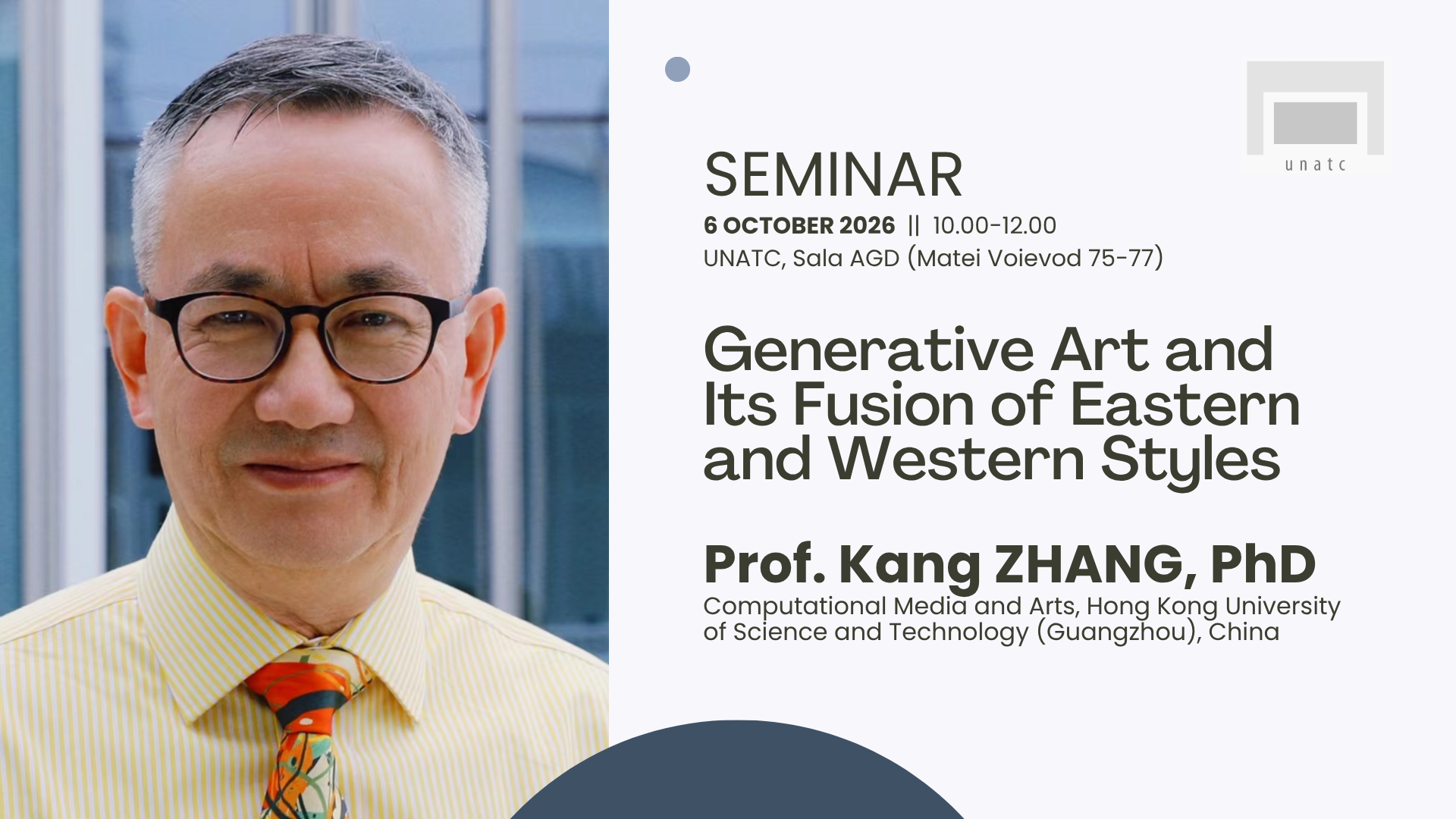
Generative Art and Its Fusion of Eastern and Western Styles
Prof. Kang ZHANG, PhD – Computational Media and Arts, Hong Kong University of Science and Technology (Guangzhou), China
SEMINAR – 6 October 2026, 10.00-12.00, UNATC (Matei Voievod Street 75-77)
In this talk, I will first focus on conceptual and theoretical foundation of generative art, part of computational aesthetics. Specifically, generative visual art is defined in terms of visual languages, and thus the roles of artists and generative systems become clear. I will then present our recent practices in generative art and design for the effective fusion of Eastern and Western artistic styles. The first practice combines the styles of Wassily Kandinsky and Wu Guanzhong, who are both great masters of using points, lines and planes in their paintings. The AI-fused Eastern and Western styles yield highly aesthetic images. The second practice applies AI techniques to Dongba scripts of the Chinese minority group Naxi in Yunnan Province, and then generates Miro’s surrealism style. Both works have been successfully applied to produce highly demanded design products. Other recent research in computational aesthetics will also be mentioned.
Short Bio
Kang Zhang is Professor and Former Head of Computational Media and Arts, Information Hub, Hong Kong University of Science and Technology (Guangzhou), Professor of Division of Emerging Interdisciplinary Areas, HKUST, Professor Emeritus of Computer Science, The University of Texas at Dallas, and Guest Professor of China Academy of Arts. He was a Fulbright Distinguished Chair and among Stanford’s List of 2023-2025 World’s Top 2% Scientists (Lifetime Impact), and held academic positions in China, the UK, Australia and USA. Zhang’s current research interests include computational aesthetics, visual languages, and generative art and design; and has published 8 books, and over 130 journal papers in these areas. He has delivered keynotes at art and design, computer science, and management conferences and forums.