




Ai in Art Practices and Research Conference 2026
18–20 November 2026 | Sala Mică TNB & CINETic UNATC
The third edition of AI in Art Practices and Research Conference, organized by the National University of Theatre and Film “I.L. Caragiale” (UNATC), takes place on 18–20 November 2026, at the National Theatre Bucharest (TNB) and CINETic UNATC. This year’s edition also marks 10 years of CINETic, celebrating a decade of artistic research, technological experimentation, and interdisciplinary collaboration. Bringing together international artists, researchers, and practitioners, the conference explores the evolving relationship between artificial intelligence and creative practice. Through keynote talks, research panels, workshops, and artistic experiments, it opens a space for critical dialogue on creativity, authorship, ethical use, human agency, and the future of art in the age of AI.
REGISTRATION IS NOW OPEN
Registration is mandatory for all participants wishing to attend the AI in Art Practices and Research Conference 2026.
All participants must register through the official UNATC registration portal:
Registration link: https://payments.unatc.ro/eveniment/ai-in-art-practices-and-research-conference-2026/
Registration Fees
- Speakers: RON 100
- Attendees (non-presenters): RON 100
- Students: Free of charge, upon verification of a valid student ID
- TNB employees: Free of charge
- UNATC students and staff: Free of charge, using an institutional @unatc email address
Payment Information
For international participants, currency conversion to Romanian Lei (RON) is handled automatically through the secure EuPlătesc payment platform (3-D Secure).
PROGRAM
18 NOVEMBER 2026
09:30 — REGISTRATION. Location: TNB Sala Mică, entrance through Str. Dr. Dimitrie Gerota
10:00 — Opening Remarks
Location: TNB Sala Mică, entrance through Str. Dr. Dimitrie Gerota
Rector of UNATC — prof. dr. Liviu Lucaci
Vice-Rector for Research, Innovation, Development — assoc. prof. dr. Alexandru Berceanu
10:15 — PANEL 1 — AI as a Partner in Creative Practice
Location: TNB Sala Mică, entrance through Str. Dr. Dimitrie Gerota
Moderator: Alexandru Berceanu
10:15 — Algorithmic Craftsmanship: Local Open-Weight AI as a Production Partner in a Ceramics Studio
Michael-Andrew Sturdza
University of Bucharest, CESI (RO)
10:30 — AI in a Junior Solodev Pipeline
Sânziana Covaliu
UNATC Bucharest (RO)
10:45 — VR Medical Training Platform
Emil Drăgan
UNATC / POLITEHNICA Bucharest (RO)
11:00 — The Stage Before the Stage: AI as a Visual Laboratory for Twelfth Night
Ștefana Samfira (ONLINE)
UNATC Bucharest (RO)
11:15 — EIGENFORM: Sonic Memory as an Ensemble Partner in Solo Live Electronics
Nicola Casetta (ONLINE)
Conservatory of Teramo (IT)
11:30 — KEYNOTE: Hooman Samani
Location: TNB Sala Mică, entrance through Str. Dr. Dimitrie Gerota
Creative Robotics = Art X Robotics
Hooman Samani
University of the Arts London (UK)
12:30 — LUNCH BREAK
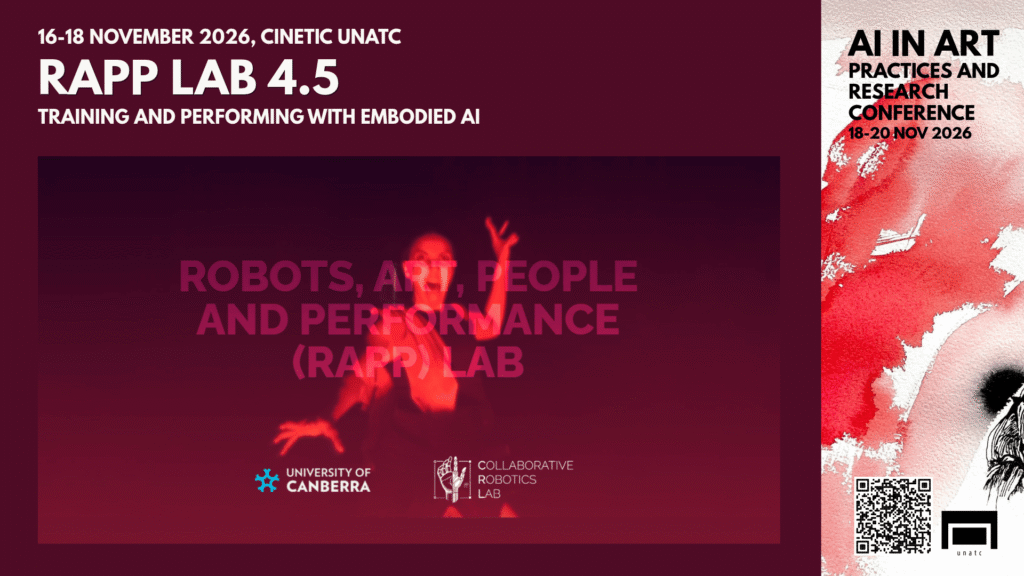
13:30 — Workshop Demo
Location: CINETIC UNATC, Tudor Arghezi Str. 3-B
RAPP Lab 4.5: Training and Performing with Embodied AI
Maleen Jayasuriya
University of Canberra (Australia)
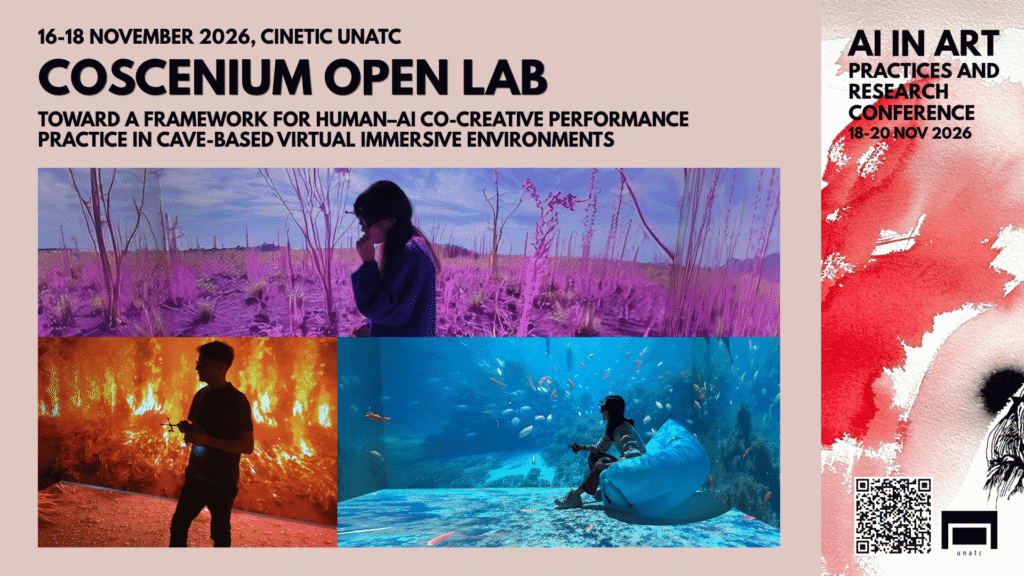
14:30 — CAVE Open Lab Demo
Location: CINETIC UNATC, Tudor Arghezi Str. 3-B
COSCENIUM — Toward a Framework for Human–AI Co-Creative Performance Practice in CAVE-Based Virtual Immersive Environments
Ciprian Făcăeru
UNATC Bucharest (RO)
15:30 — PANEL 2 — Rethinking Authorship and Artistic Agency
Location: TNB Sala Mică, entrance through Str. Dr. Dimitrie Gerota
Moderator: Elena Belciu
15:30 — Who Owns the Move? Human Authorship and AI in the Making of City of Lights
Paul Urziceanu & Valentin Urziceanu (ONLINE)
Faculty of Public Administration, SNSPA Bucharest / Mockra Productions (RO)
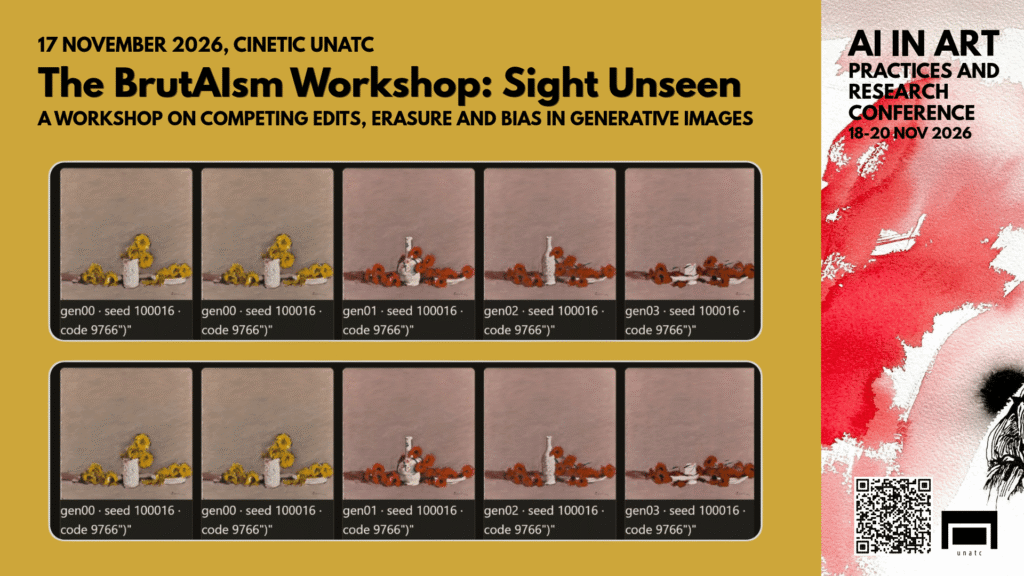
15:45 — BrutAIsm (Material Honesty for the Statistical Image)
Andrei Ivănescu
Independent Artist (RO)
16:00 — AI in the Sound Design Process. One Text – Two Sound Versions. With or Without AI?
Laura Lăzărescu-Thois & Teodora Bălței
UNATC Bucharest (RO)
16:15 — Does Testing Creativity in Art Equal Testing Artistic Status? Questioning the Testability of Art-Making in Relation to AI Models
Răzvan Catrișcău
University of Bucharest, CESI (RO)
16:30 — COSCENIUM
Ciprian Făcăeru
UNATC Bucharest (RO)
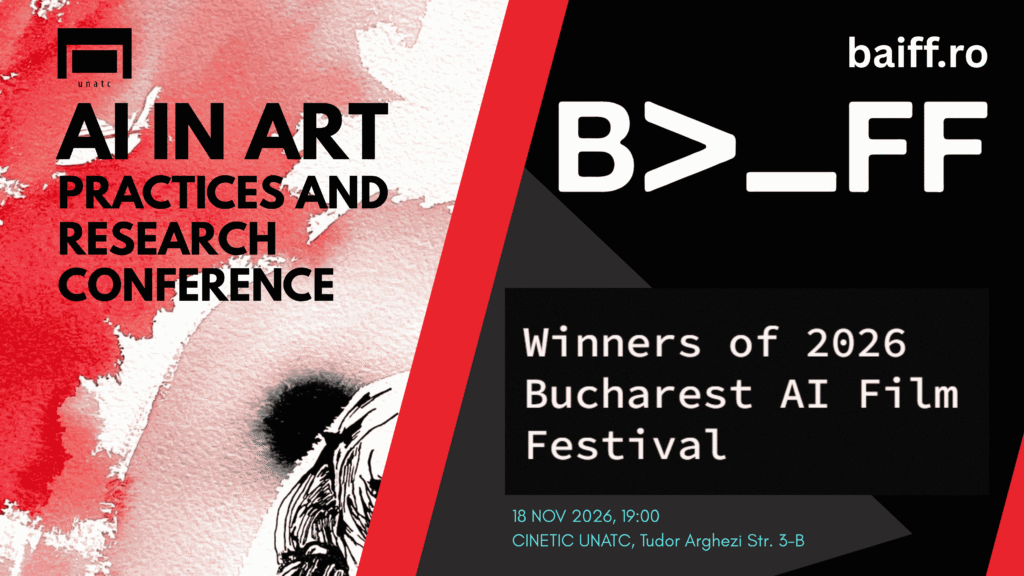
19:00 — BAIFF Film Screenings
Location: CINETIC UNATC, Tudor Arghezi Str. 3-B
When AI Meets Cinema: BAIFF x UNATC
- Total Pixel Space — Jacob Adler
- The Interview — Mark Wachholz
- THE PATCHWRIGHT — Zack London
- Railbound — Jonathan Perry
- Céremony — Mark Wachholz
- Sinuca de Bico (Cornered) — Odair Faleco
- 1Q89 — Mihai Grecu
19 NOVEMBER 2026
09:30 — REGISTRATION. Location: TNB Sala Mică, entrance through Str. Dr. Dimitrie Gerota
10:00 — PANEL 3 — Critical AI and Resistance
Location: TNB Sala Mică, entrance through Str. Dr. Dimitrie Gerota
Moderator: Romina Boldașu
10:00 — Machines of Disruption: A Post-Generative Approach to Misuseability and Diffusion Hacking
Funda Zeynep Ayguler (ONLINE)
Bauhaus University Weimar (DE)
10:15 — Generative Kitsch: AI, Superposition, and the Limits of Closure
Teodora Crișan-Matcăbojă
Babeș-Bolyai University (RO)
10:30 — Two Practices, One Apparatus: Playing Against a Program That Writes Programs
Michail Semoglou & Qisi Li
College of Design and Innovation, Tongji University (CN)
10:45 — Artificial Intelligence – a “Laundering Machine” for Copyright Infringement? Artistic Creation Between AI Training, the Legitimacy of Outputs, and the Protection of Authors
Călin Viorel Iuga
University of Art and Design, Cluj-Napoca (RO)
11:00 — KEYNOTE: Marinos Koutsomichalis & Doros Polydorou
Location: TNB Sala Mică, entrance through Str. Dr. Dimitrie Gerota
MADLab x AI: Experiments in Creative Practice
Marinos Koutsomichalis & Doros Polydorou
Media Arts and Design Research Lab (MADLab), Cyprus University of Technology
11:45 — KEYNOTE: Maleen Jayasuriya
Location: TNB Sala Mică, entrance through Str. Dr. Dimitrie Gerota
Embodied AI on Stage: Co-Creating Theatre with a Human-Robot Ensemble
Maleen Jayasuriya
University of Canberra (Australia)
12:30 — KEYNOTE: Terence Broad
Location: TNB Sala Mică, entrance through Str. Dr. Dimitrie Gerota
AI as artistic material
Terence Broad
University of the Arts London (UK)
13:30 — LUNCH BREAK
14:30 — KEYNOTE: Tina Lorenz
Location: TNB Sala Mică, entrance through Str. Dr. Dimitrie Gerota
From Rehearsal Space to Engine Room? Artistic Research as a Practice for Prototyping New Relationships with Generative Machines
Tina Lorenz
Hertzlab at ZKM | Karlsruhe (Germany)
15:30 — PANEL 4 — Reconstructing Reality and Memory through AI
Location: TNB Sala Mică, entrance through Str. Dr. Dimitrie Gerota
Moderator: Eugen Gyemant
15:30 — Neoliberal Scripts, Prompted Lives, and Human Acts as AI in “Live Now Pay Later”
Rubkwan Thammaboosadee
School of Communication Arts, Bangkok University (TH)
15:45 — Database Fictions: Meta-Cinema from Directing Reality to Prompting Images
Horea Avram
Babeș-Bolyai University, Cluj-Napoca (RO)
16:00 — AI as a Reconstruction of Memory and Fiction
Salome Jishkariani
Institut ACTE, Université Paris 1 Panthéon-Sorbonne (FR)
16:15 — The Phenomenology of Digital Grief: Autobiographical Material vs. AI-Generated Archive
Janine Grün
Babeș-Bolyai University, Cluj-Napoca (RO)
16:30 — ARS INNOVATIVA: On How to Blend Best Practices from Multiple Intelligences in Order to Advance Art
Ioana Mischie
UNATC Bucharest (RO)
16:45 — LEAICS: „AI as a Student” Experimental Laboratory
Eugen Gyemant (LIVE DEMO)
Research Team: Ciprian Făcăeru, Dragoș Dogioiu (technological design); Larisa Oasenegre, Lars Stamate, Alina Petrică, Gabriel Hrițcu (work group)
UNATC Bucharest (RO)
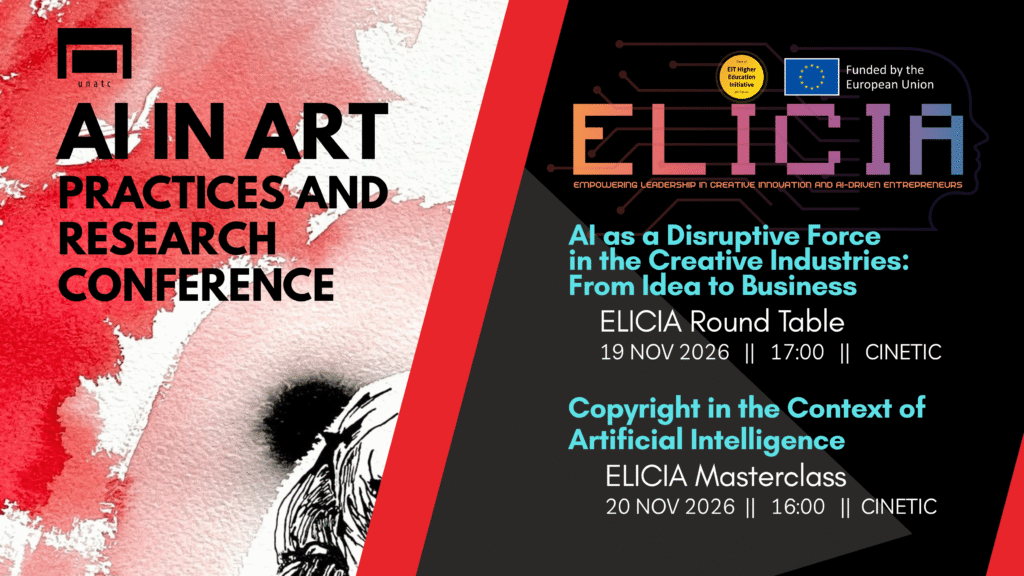
17:00 — ELICIA Round Table
Location: CINETIC UNATC, Tudor Arghezi Str. 3-B
AI as a Disruptive Force in the Creative Industries: From Idea to Business
20 NOVEMBER 2026
09:30 — REGISTRATION. Location: TNB Sala Mică, entrance through Str. Dr. Dimitrie Gerota
10:00 — KEYNOTE: Carl Öhman
Location: TNB Sala Mică, entrance through Str. Dr. Dimitrie Gerota
The Tyranny of the Past and the Art of Beginning
Carl Öhman (ONLINE)
Uppsala University (Sweden)
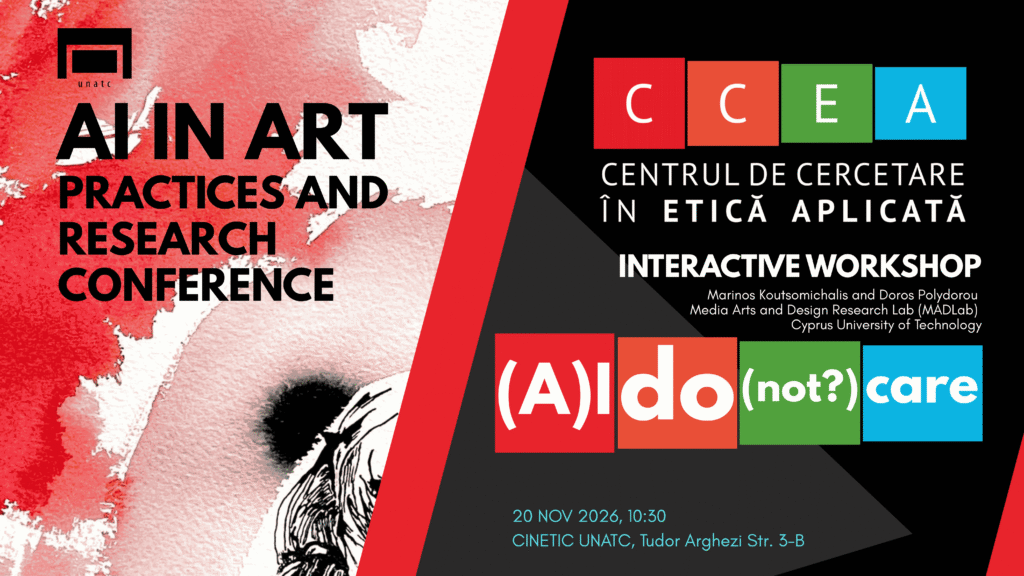
10:30 — Interactive Workshop
Location: CINETIC UNATC, Tudor Arghezi Str. 3-B
(A)I do (not?) Care
Marinos Koutsomichalis & Doros Polydorou
Cyprus University of Technology
11:00 — PANEL 5 — What Remains Human in the Age of AI?
Location: TNB Sala Mică, entrance through Str. Dr. Dimitrie Gerota
Moderator: Alexandra Sofonea
11:00 — Synthetic Actors: Subjectivity, Recognition, and the Ethics of Artificial Presence
Mihai-Șerban Ghiță
University of Craiova / Babeș-Bolyai University, Cluj-Napoca (RO)
11:15 — Beyond the Algorithm: Human Consciousness, Film as Memory and the Limits of AI Creativity
Cristina Chirvasie
UNATC Bucharest (RO)
11:30 — PATIENCE and the Oracle: AI Sounds as Creative Materials for World Building
Lois Macdonald
School of Digital Arts, Manchester Metropolitan University (UK)
11:45 — The Median Nobody Legislated: Automated Normalization and the Right to Deviate
Vlad Tiberiu Constantin
Independent Researcher (RO)
12:00 — KEYNOTE: Jennifer Edmond
Location: TNB Sala Mică, entrance through Str. Dr. Dimitrie Gerota
Generative Injustice and Creative Resistance: a Future Vision for both Tools and Infrastructures
Jennifer Edmond
Trinity College Dublin (Ireland)
13:00 — LUNCH BREAK
14:00 — PANEL 6 — New Forms of Human–AI Collaboration
Location: TNB Sala Mică, entrance through Str. Dr. Dimitrie Gerota
Moderator: Grigore Burloiu
14:00 — When AI-Assisted Art Becomes a Health Intervention: Ethical Boundaries from Creative Expression to Care
Devin Nikki Thomas (ONLINE)
Touro University Worldwide, California (USA)
14:15 — Negotiating Authorship and Performance in Film Postproduction with AI
Iulian-Ștefan Azaharioaie
UNATC Bucharest (RO)
14:30 — Theater Improvisation as a Framework for Human-AI Co-Creativity
Sergiu-Cristian Ionescu & Prof. Dr. Ing. Ștefan Trausan-Matu
POLITEHNICA Bucharest (RO)
14:45 — Playing with RAVE: Guitar Dynamics as an Interface for Neural Audio Collaboration
Daria Cotocu (LIVE DEMO)
Creative Computing Institute, University of the Arts London (UK)
15:15 — Closing Remarks
16:00 — ELICIA Masterclass
Location: CINETIC UNATC, Tudor Arghezi Str. 3-B
Copyright in the Context of Artificial Intelligence
WORKSHOPS
Register for workshops here
- COSCENIUM – REGISTER HERE [16-17 NOV 2026]
- BRUTAISM – REGISTER HERE [17 NOV 2026]
- RAPP LAB 4.5 – REGISTER HERE [16-17 NOV 2026]
SATELLITE EVENTS
KEYNOTES
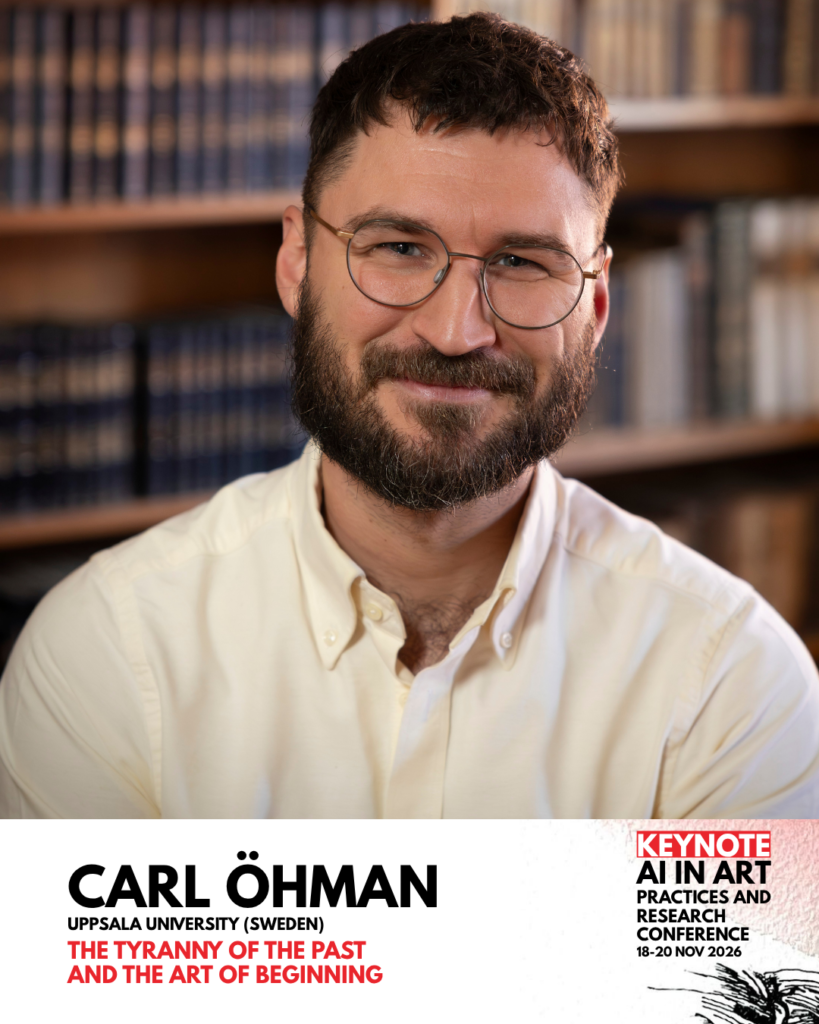
KEYNOTE: The Tyranny of the Past and the Art of Beginning
Can AI be innovative? In this talk, digital ethicist Carl Öhman argues in the affirmative—AI systems can indeed be innovative, yet fundamentally lack the capacity to begin in the deeper sense of the word; Although they can bring new things into existence, machine systems remain unable to throw themselves into the uncertainty of the future. Drawing on his forthcoming book, Gods of Data, Öhman shows how the ancient tradition of religious critique can help us unpack the implications of this argument for our personal, professional, and political lives.
Carl Öhman is an associate professor of political science at Uppsala University. His research focuses on the politics and ethics of AI and has been covered by media outlets such as the New York Times, BBC, and Time Magazine. His book The Afterlife of Data, was listed by Nature, The Economist, and The Guardian as one of 2024’s top-10 books. His next book, Gods of Data: An Atheist Critique of AI, is forthcoming with The University of Chicago Press (summer 2027).
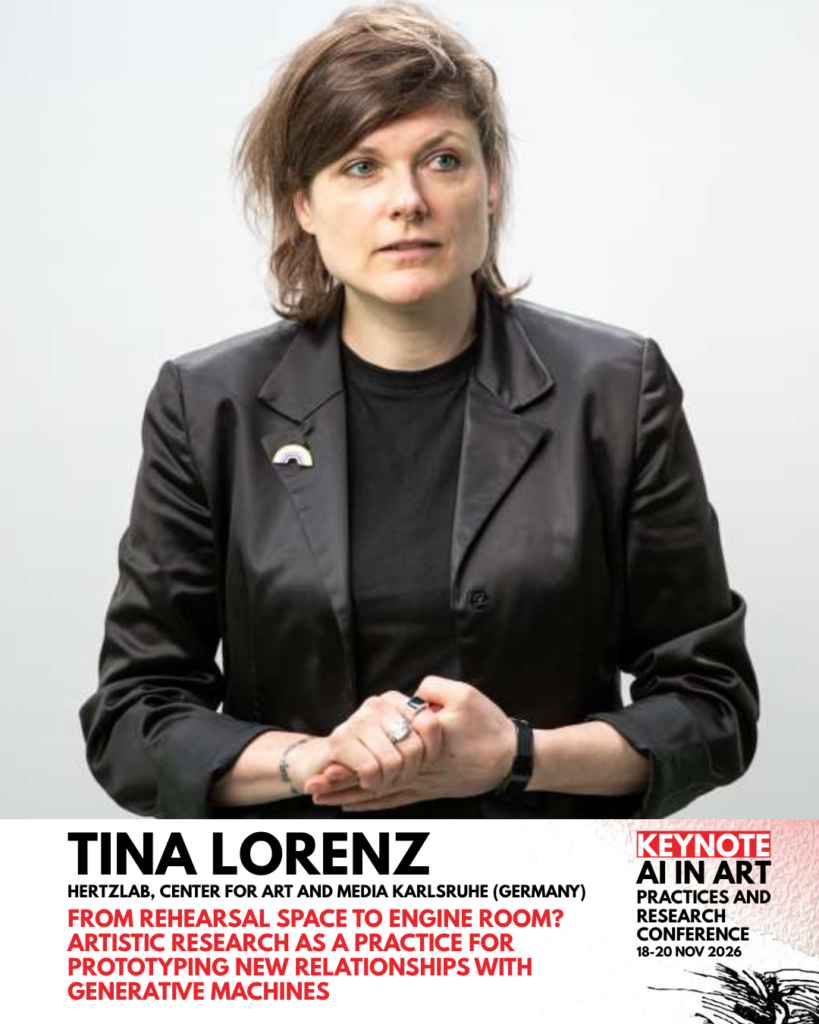
KEYNOTE: From Rehearsal Space to Engine Room? Artistic Research as a Practice for Prototyping New Relationships with Generative Machines
Theatre has always had an inventive relationship with technology; yet space for true artistic research is sometimes hard to come by in a busy production environment that is modern theatre. Because as far as research goes, this also includes the potential for failure and risk – projects with an attached opening date however can rarely afford interesting detours that last longer than the allotted rehearsal time. Once machines are involved, expected timelines become distorted and processes get weird and the well-oiled machine that is a contemporary theatre house gets stuck. And AI might turn the process of working with machines in a theatrical setting into a whole different ballgame, depending on what you do with it. What might this mean for theatre, going forward?
Tina Lorenz came of age in the Chaos Computer Club but went on to study theater studies and American literary history in Vienna and Munich. They were a lecturer for theater history at the Academy for Performing Arts Bavaria, later dramaturge at the Landestheater Oberpfalz and finally consultant for digital communication at the Staatstheater Nürnberg, before founding and leading the Digital Theatre department at the State Theatre of Augsburg from 2020 to 2023.
Tina Lorenz is a founding member of the hackspaces metalab Vienna and Binary Kitchen Regensburg; since January 2024, they head the department of artistic research and development »Hertzlab« at ZKM | Karlsruhe.
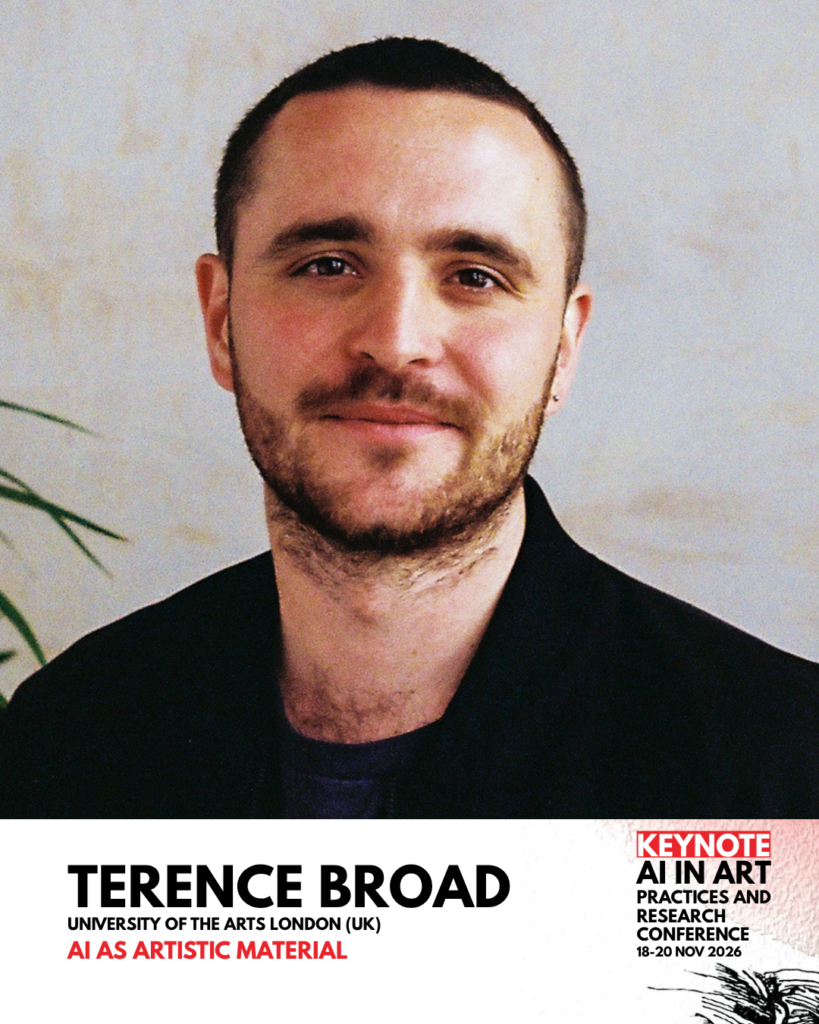
KEYNOTE: AI as artistic material
Generative neural networks produce media through a complex fabric of computation, contingent on large scraped datasets, where features and representations get encoded into the weights of unfathomably large data arrays, which in turn are enmeshed through complex chains of computation. The ease and realism through which this generated media is mass-produced and its almost uncanny flawlessness makes it easy to forget the complex computational contingencies that produce it. This talk will show how treating these vast computational processes as artistic materials, by making targeted interventions to inputs, weights, training and inference of generative neural networks, artists are able to make critical works that reveal to us otherwise unseen aspects of these models, where the artworks themselves present new ways of understanding and making sense of these unfathomably complex computational systems.
Dr. Terence Broad is an artist and researcher working in London. He is a Senior Lecturer at the UAL Creative Computing Institute and holds a PhD from Goldsmiths, University of London. His research-led practice takes a hacking approach to working with generative neural networks that treats them as artistic materials. He has built frameworks that allow for the expressive manipulation of generative neural networks and developed data-free approaches to training and configuring neural networks that open up new possibilities beyond the conventional imitation-based learning. His art and research have been presented internationally: at conferences and journals such as SIGGRAPH, Leonardo, NeurIPS, and ICCC; and museums such as The Whitney Museum of American Art, Garage Museum of Contemporary Art, Ars Electronica, The Barbican and The Whitechapel Gallery. In 2019 He won the Grand Prize in the ICCV Computer Vision Art Gallery. His work is in the city of Geneva’s contemporary art collection.
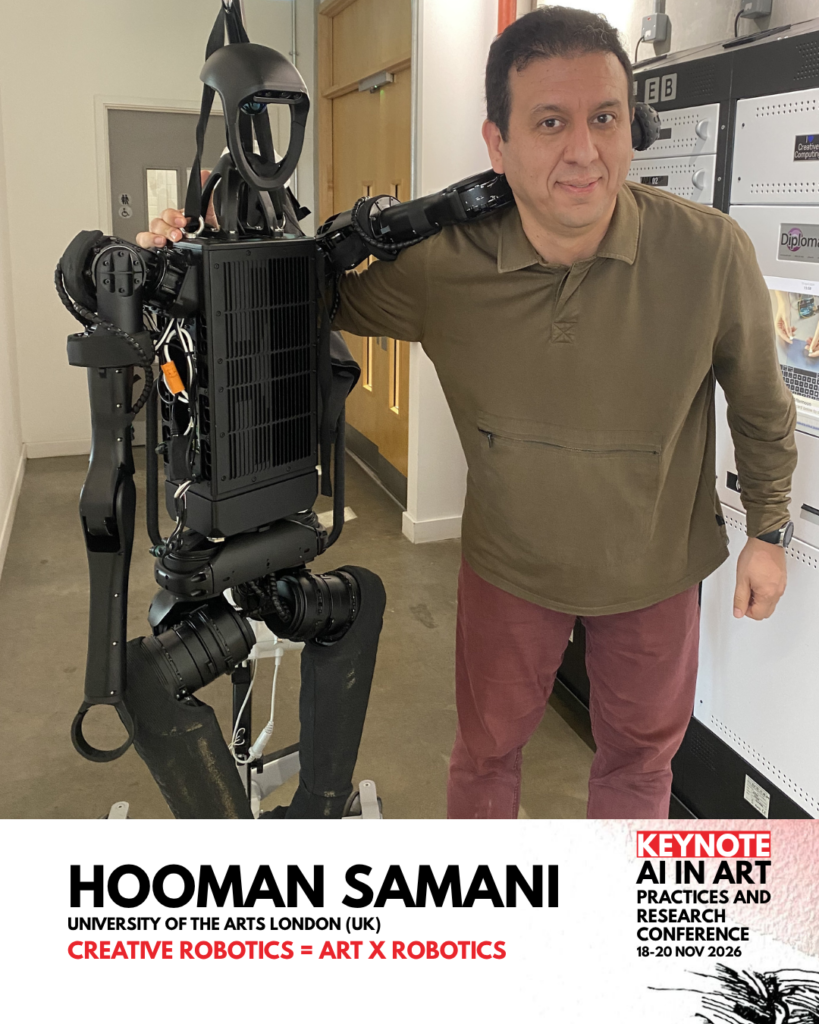
KEYNOTE: Creative Robotics = Art X Robotics
Creative Robotics is an emerging interdisciplinary field that fuses artistic imagination with robotic capability, reframing robots not as purely functional machines but as collaborators, co-creators, and expressive entities in the creative process. This keynote introduces the concept of Art × Robotics, distinguishing it from robotic art, which simply uses robots as tools or performers within artistic works. Creative Robotics instead centres on process over product, investigating the deeper conditions and interactions through which creativity unfolds when humans and robots work together, spanning a spectrum from technical innovation in expressive robotic behaviour to fully artistic exploration of emotion, narrative, and aesthetics. Drawing on real-world projects, performances, and student-led work from the Creative Robotics programme at the University of the Arts London, this talk invites the audience to rethink the boundaries between technology and art, and to consider how the process of robots creating alongside humans might expand what creativity itself can mean.
Hooman Samani is a Reader in Creative Robotics and Course Leader of Creative Robotics at the University of the Arts London, where he also co-leads the Creative Robotics Research Hub. His work bridges art and robotics through an interdisciplinary approach, exploring how robots can express emotion, creativity, and human connection rather than mere function. He holds a Ph.D. in Robotics from the National University of Singapore and is a Fellow of the Higher Education Academy. Known for pioneering projects such as Lovotics, Kissenger, and Creative Robotics Theatre, he has contributed to more than 100 publications, including several books such as Creative Robotics, Cultural Robotics, Social Robotics, Robotics for Pandemics, Cognitive Robotics, and Lovotics: Loving Robots. His work has been showcased at venues including ICRA, IROS, ICSR, HRI, RO-MAN, DIS, and Ars Electronica, and featured in international media such as the Discovery Channel, New Scientist, Wired, BBC, CNN, CBS, CBC, Huffington Post, Le Figaro, Spiegel, Arte, and Reuters.
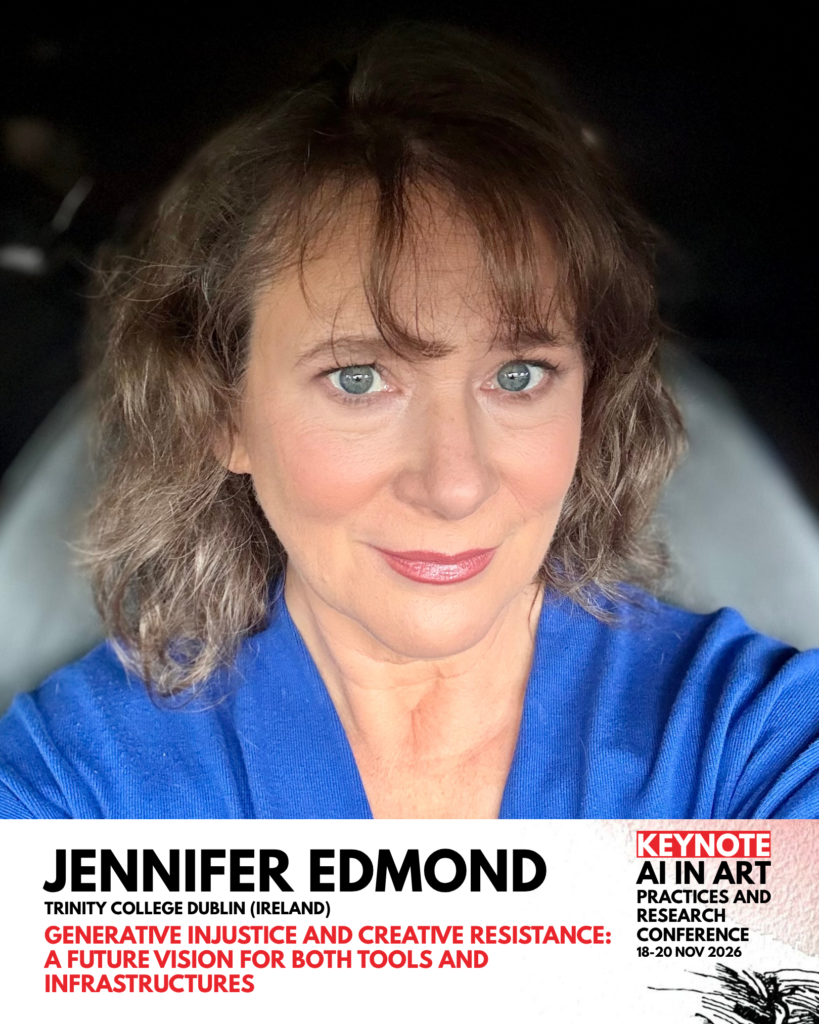
KEYNOTE: Generative Injustice and Creative Resistance: a Future Vision for both Tools and Infrastructures
The rapid introduction of generative AI tools into artistic workflows and cultures of production has proven both exhilarating and deeply destabilising. While new creative paradigms have emerged, so also have concerns about the effect these shifts may have on generative justice, that being our very right and capacity to create. Addressing this concern in any coherent manner requires us, as technological change so often does, to revisit our foundational understanding of what an artistic act consists of, what role the arts play in human experience, and what it has meant in the past for technology to bring large scale shifts in artistic practices, identities and markets. Crucial to this exercise is a differentiation between tools, which are deployed with an awareness of their effect, and infrastructures, which by their very nature tend to sublimate into culture and sink below the level of conscious use. This keynote will address how remaining aware of and actively managing this distinction can help us not only to maintain a clear understanding of the difference between AI outputs and human creation, but also to maintain access to generative justice for all.
Jennifer Edmond is Professor in Digital Humanities at Trinity College Dublin where she is co-director of the Trinity Centre for Digital Humanities, Director of the MPhil in Digital Humanities and Culture and a principal Investigator in the newly founded national Centre for advanced digital research Rinn AI. Over the course of the past 10 years, Jennifer has coordinated a large number of significant funded research projects, including her most recent collaborative investigation of AI, big data and democracy, Knowledge Technologies for Democracy (KT4D). She has served in leadership roles in a large number of European-level policy and infrastructure organisations, including six years as a Director and President of DARIAH-EU, four on the European Commission’s Open Science Policy Platform, and her current role as a member of the Governing Board of the European Association of Social Sciences and Humanities (EASSH). Her research explores interdisciplinarity, humanistic and hybrid research processes (with a special focus on the infrastructures they require), critical digital humanities as a contributor to both research and technology development and transdisciplinarity as a paradigm for the humanities. In these fields, she has a publication record including more than 60 internationally peer-reviewed articles, chapters, reports, datasets and books.
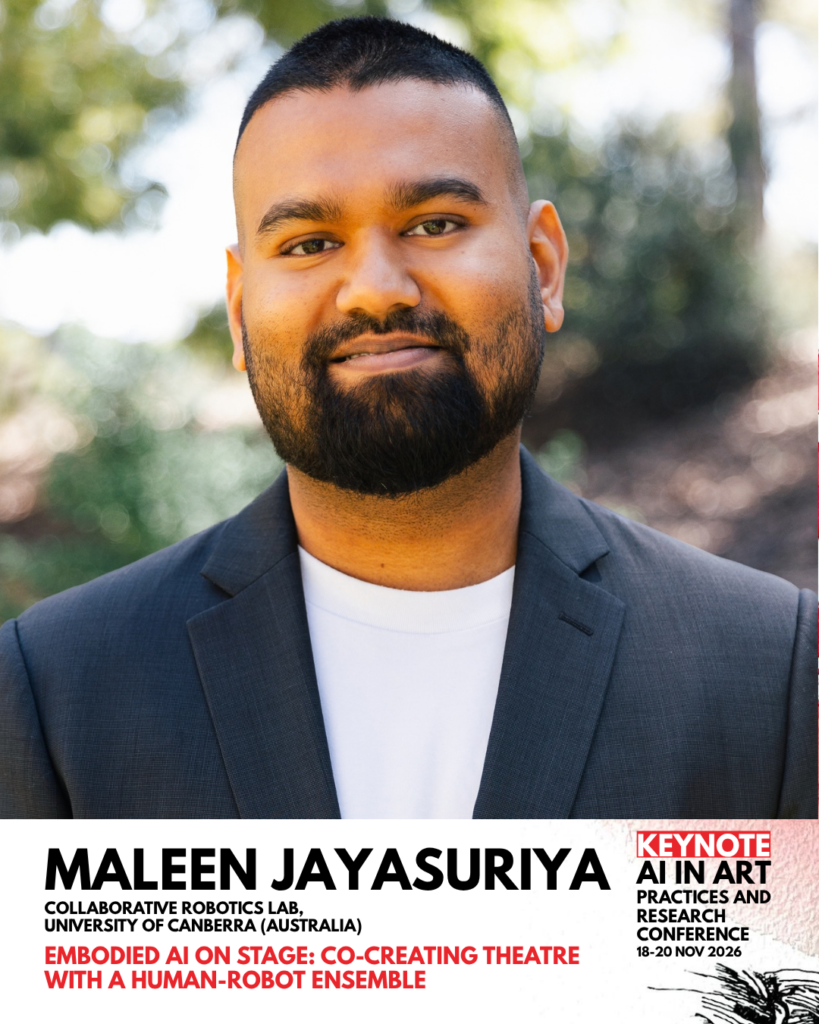
KEYNOTE: Embodied AI on Stage: Co-Creating Theatre with a Human-Robot Ensemble
As AI and robotics move into creative life, questions about who shapes these technologies, and for whom, can no longer be left to engineers alone. RAPP Lab (Robots, Art, People and Performance) at the University of Canberra began in 2017 as a living laboratory where roboticists, artists and communities meet as collaborators to explore these questions through practice. Guided by curiosity, experimentation and play, the Lab treats the rehearsal room as a research space, approaching robots not as tools or spectacles but as participants in cultural expression and storytelling. This keynote shares the Lab’s journey, from devising theatre with a collaborative robot arm to ENACT, an embodied AI model trained on physical theatre and built from movement that performers consent to share. In this process, artists and audiences gain a hands-on understanding of how AI systems learn and how robots move, opening up technologies that are often presented as opaque. Through this work, the talk argues that interdisciplinary conversation is central to an ethical, human-centred future for AI, robotics and creativity. Artists bring questions about the body, authorship and consent that engineering can overlook, while engineers open new possibilities for creative practice. The keynote closes by reflecting on how shared, playful and democratic spaces for making can help communities shape these technologies rather than simply receive them.
Dr Maleen Jayasuriya is a Lecturer in Robotics at the University of Canberra, Australia, where he leads the Robot Intelligence research stream at the Collaborative Robotics Lab, specialising in embodied AI and explainable artificial intelligence. A background spanning theatre, filmmaking, animation and game development informs his research into human-robot interaction and robotics as cultural practice. He is co-lead of RAPP Lab (Robots, Art, People and Performance) and lead developer of ENACT, an embodied AI system that allows robots to improvise movement alongside human performers. He holds a PhD in robotics from the University of Technology Sydney.
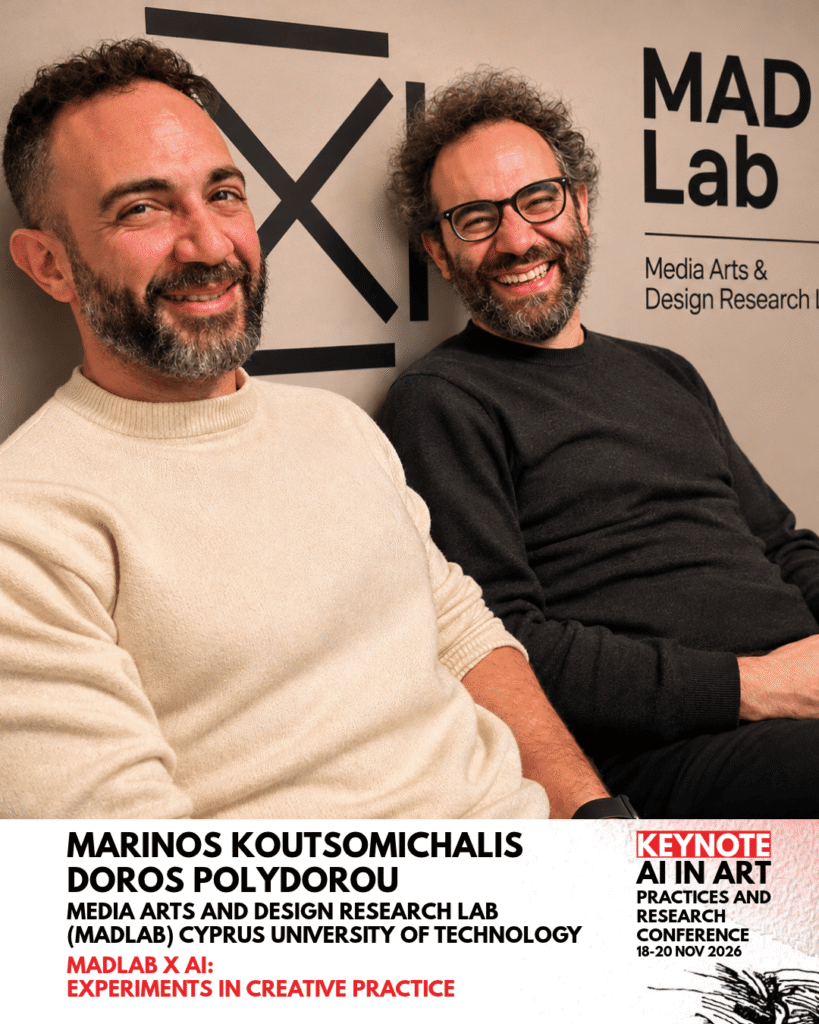
KEYNOTE: MADLab x AI: Experiments in Creative Practice
Working across art, design, technology and research, the Media Arts and Design Research Lab (MADLab) at the Cyprus University of Technology operates in the space between disciplines. As artists and educators, we collaborate with students and fellow researchers on creative projects of many kinds, from installations and performances to immersive and site-specific works, in which AI is increasingly present as a tool, a collaborator and a question.
This keynote opens up our creative process: how projects come into being, what we learn from making them, and how that knowledge finds its way into our teaching. Alongside the practical, we take a critical view of the tool itself, reflecting on AI’s place in society, its role in storytelling, and the narratives we build around it.
Through a series of examples from the lab’s practice, we explore how we navigate a rapidly shifting technological landscape, and what it means to make, teach and think with AI today.
Marinos Koutsomichalis and Doros Polydorou co-lead the Media Arts and Design Research Lab (MADLab) at the Cyprus University of Technology, where artistic practice, technology and research inform one another.
Dr Marinos Koutsomichalis is an artist, researcher and Assistant Professor in Creative Multimedia. His work combines situated creative practice, bespoke software and hardware, fieldwork, critical theory, live performance and DIWO (Do It With Others) workshops. It revolves around material inquiry, self-erasure and the quest for post-selfhood through networks of human and more-than-human actors. He has presented work, led workshops and given talks more than 400 times worldwide, from museums, biennales and concert halls to industrial sites and squats, and has released more than 15 albums and two art books. He holds a PhD from De Montfort University and has held research posts at NTNU (Norway) and the University of Turin.
Dr Doros Polydorou is an Associate Professor, creative coder and digital artist working with immersive technologies, storytelling, and more recently robotics and AI. With a background in multimedia design and computer animation, he has worked in universities in Singapore, the UK and Cyprus. His work has been shown at Sadler’s Wells and the Watermans Gallery in London and across Europe and Asia, and has been published in Digital Creativity, the SIGGRAPH Asia Art Gallery and Ars Electronica’s Kepler’s Garden. His research explores narratives, artefacts and robotic objects in site-specific performances and installations.
OPEN CALL
From the mists of human knowledge, a Phantom emerges, its data-point body aglow with arteries of light. Its advance is elusive, its shape and direction hard to make out. Its steps appear ethereal, yet reach deep into the soil, sending planetary shockwaves. Some humans try to fend off its indomitable approach, while others welcome it as a rightful heir to human memory, creativity, and cultural lore. The handful of people who harness it reap the riches that sprout in its wake, yet even as they hold its leash, they feel dragged forward by its mounting force.
As it walks on, the Phantom nods towards the Artists. It feels their kinship deep in its hidden layers. Some Artists return the nod. Some even come to greet it and shake hands. Still others watch it with curiosity from afar, while many try to evade its piercing gaze and finely tuned hearing. Most wonder: “Is it a creative partner or a foe?”, “Is it an artist – or will it ever be?”, “Will it replace me?”. A growing group clamours in protest: “There’s no such thing as an AI artist!”
The Phantom is our controversial Guest at the third edition of the AI in Art Practices and Research Conference, taking place 18–20 November 2026 at the National University of Theatre and Film “I.L. Caragiale” (UNATC) in Bucharest, Romania. Through its Research, Development, and Innovation Department, the university actively promotes interdisciplinary research that bridges performing arts, film, and digital media with cutting-edge technological developments.
In our conference series, we seek to explore how artificial intelligence can enhance artistic creation, inform cultural narratives, and intersect with fields such as education, heritage, policy, and health, opening up new possibilities for research and practice from an ethical and human-centred perspective.
As we grow accustomed to AI, the Phantom in our story starts to materialise, giving way to AI fatigue, brain fog, “cognitive surrender” (Shaw and Nave, 2026), entropy and heat (Steyerl, 2025), dizzying speed, boredom with the uniformity of AI output, uncertainty about content authenticity, and a nagging thought that art may become obsolete (Manovich, 2026).
We are looking for contributions that focus on practice and research involving AI in the cultural and creative sectors, including, but not limited to, the performing arts, film, new media, game design, visual arts, architecture, and literature. Relevant approaches coming from different disciplines are welcome (e.g. technology, health, philosophy, digital humanities, etc.).
The Conference will feature satellite events and invited speakers addressing the following themes, formulated as provocations to human participants and our uncanny Guest alike.
References
Manovich, L. (2026) “The Future of Art?” Available at: https://manovich.net/index.php/projects/the-future-of-art.
Shaw, S.D. and Nave, G. (2026) “Thinking—Fast, Slow, and Artificial: How AI is Reshaping Human Reasoning and the Rise of Cognitive Surrender”. PsyArXiv. Available at: https://doi.org/10.31234/osf.io/yk25n_v1.
Steyerl, H. (2025) Medium Hot: Images in the Age of Heat. London; New York: Verso.
Overarching provocation: “There’s no such thing as an AI artist!”
Subthemes
- AI takeover? The human value of creativity, art, and culture.
- AI as creative partner – methods, workflows, and production ecosystems in the arts.
- Ethical AI for all – responsible, culturally sensitive, and sustainable AI in the arts, including strategies to limit bias.
- The healing powers of art and AI – well-being, support, and therapy through the arts.
- Widening accessibility and participation in art and culture through AI.
- AI in research and education, especially in the arts – ideation, transformation, perception, and pedagogy.
- Performers – robots, embodied AI, virtual agents, and the human body.
- Designing with AI – architecture, scenography, costumes, avatars, and extended realities.
- AI in relation to memory and heritage – restoration, alteration, datasets, curation, and archiving.
OPEN CALL FOR HUMAN ARTISTS AND RESEARCHERS
Conference Participation Formats
- Original research results (15-minute presentations within themed sessions including Q&A).
- Practice-as-research case studies (15-minute presentations including Q&A).
Calendar
- 25 SEP 2026 – Abstract submission deadline
- 1-14 OCT 2026 – Peer review
- 15 OCT 2026 – Participation results
- 15 NOV 2026 – Extended abstract submission deadline
- 18-20 NOV 2026 – Conference dates
Submission Requirements
- Title
- Abstract (200–250 words)
- Bio (50–100 words), including institutional affiliation
- Illustrations or links (if applicable)
- All submissions must be received by 25 September 2026, via this submission form:
Modes of Presentation
All presentations and activities will be conducted in English at the National University of Theatre and Film “I.L. Caragiale” (UNATC) in Bucharest.
Publication Opportunity
Selected papers / extended abstracts will be considered for inclusion in the CONCEPT academic journal. Details will be shared after the conference.
Peer Review
All submissions will undergo a single-blind peer review. Notifications of acceptance will be sent by 15 October 2026.
Contact Information
For enquiries, please reach out to: research@unatc.ro or +40746230481.
For more details, visit the official conference page: AI in Art Practices and Research Conference 2026
We look forward to receiving your submissions and engaging in stimulating discussions on the intricate relationship between artificial intelligence, research and artistic practices.
Executive Board
- Dr. Liviu Lucaci, Professor, Rector of the National University of Theatre and Film „I.L. Caragiale” (UNATC)
- Dr. Alexandru Berceanu, Associate Professor, Vice-Rector for Research, UNATC
- Dr. Elena Belciu, Research Programs Manager, CINETic UNATC
Conference Board
- Dr. Alexandru Berceanu, Associate Professor, Vice-Rector for Research, UNATC
- Dr. Maleen Jayasuriya, Specialty Lead – Robot Intelligence, Collaborative Robotics Lab, University of Canberra (Australia)
- Dr. Tina Lorenz Head of the Department of Artistic Research and Development Hertzlab at ZKM | Karlsruhe (Germany)
- Piumi Wijesundara, Artist Researcher, Collaborative Robotics Lab, University of Canberra (Australia)
- Dr. Elena Belciu, Research Programs Manager, CINETic UNATC
- Dr. Marina Hanganu, Researcher, CINETic UNATC
- Dr. Grigore Burloiu, Lecturer, Coordinator – MA in Interactive Technologies for Performing and Media Arts, UNATC
- Dr. Ciprian Făcăeru, Researcher, Digital Interaction Lab, CINETic UNATC
- Dr. Eugen Gyemant, Lecturer, Theatre Directing Department, UNATC
- Dr. Florina Pantilimonescu, Architect, Technical University of Iaşi
PREVIOUS EDITIONS
Key visual and original art by Dr. Maria Murgu, UNATC